
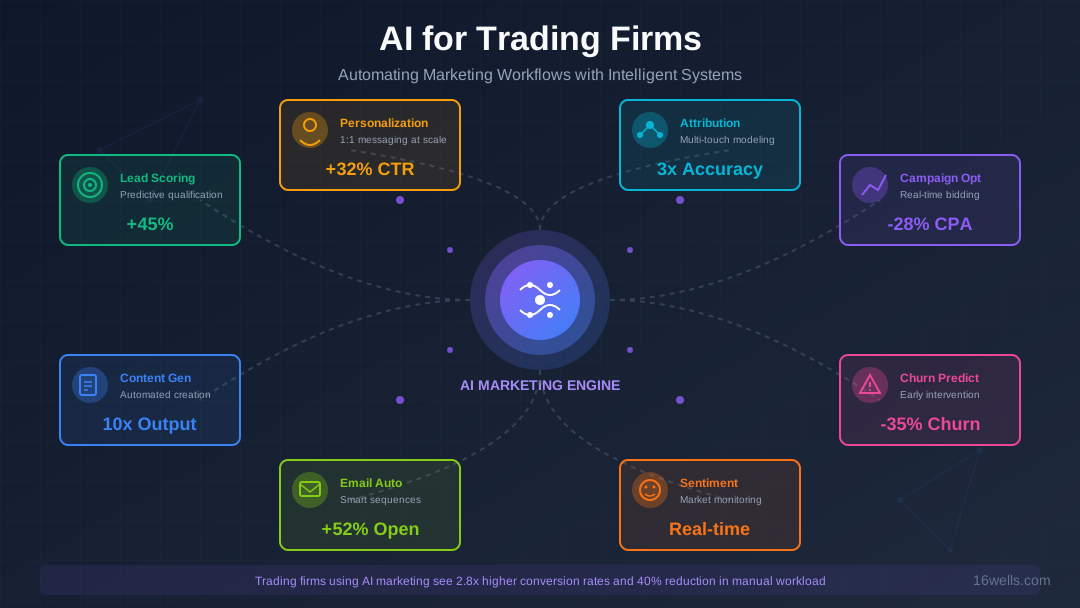
The AI Reality Check for Data-Driven Businesses
Every week, someone asks me whether AI is about to replace their marketing team. The honest answer: no, but it will make smaller teams dramatically more capable—if you implement it correctly.
Here’s the reality: AI tools have genuine productivity benefits, but they also have real limitations. They can’t replace human judgment, especially in regulated industries. They can’t understand your customers as deeply as your best people. They make mistakes that require human oversight. But for the right tasks, they can save 50-80% of time while maintaining or improving quality.
For financial services firms and B2B companies specifically, the opportunity is significant because you have high-value, information-intensive marketing. You produce educational content. You qualify leads based on complex criteria. You personalize communications for different customer segments. These are exactly the areas where AI excels.
Let me walk through the five most practical applications I’ve seen actually work in financial services marketing—not hypotheticals, but real implementations that are saving time and improving results today.
Application #1: Lead Scoring and Prioritization
The Problem AI Solves
Many B2B and financial services companies generate more leads than their sales team can effectively work. A typical scenario: your marketing generates 500 leads per month, but your sales team can only have meaningful conversations with 100. Which 100 should they focus on?
Traditional lead scoring uses simple rules: lead downloaded whitepaper = 10 points, lead visited pricing page = 20 points, lead is in target industry = 15 points. These rules are better than nothing, but they’re based on assumptions about what predicts conversion, not actual data about what predicts conversion.
How AI Does It Better
Machine learning models analyze your historical conversion data to identify patterns humans miss. They might find that:
- Leads who visit your “about us” page before pricing convert at 3x the rate
- Leads who engage on weekends are 2x more likely to become high-value customers
- Leads from certain referral sources have 4x higher LTV regardless of initial engagement
These patterns are often counterintuitive. You’d never write these as manual rules because you’d never guess them. But they’re predictive because the model is finding real correlations in your data.
Practical Implementation
You don’t need to build custom AI for this. Several platforms now offer AI-powered lead scoring out of the box:
- ActiveCampaign: Continually uses machine learning and your own scoring rubric
- HubSpot’s Predictive Lead Scoring: Uses your conversion data to score leads automatically
- Salesforce Einstein: Provides AI scoring integrated with your CRM data
- MadKudu: Specializes in lead scoring for B2B with good financial services applications
- Clearbit: Enriches lead data with company/individual intelligence that improves scoring
One financial services company implemented HubSpot’s predictive scoring and found that leads in the top 20% by AI score converted at 8x the rate of the bottom 20%. Their sales team now focuses exclusively on high-scoring leads, improving conversion rates while reducing time spent on low-probability prospects.
What AI Can’t Do
AI can tell you who’s likely to convert based on historical patterns, but it can’t tell you why. It also can’t adapt to new situations—if you launch a new product or enter a new market, the model needs retraining. And it can only score leads on data you have; if you’re not tracking certain behaviors or attributes, they can’t be used in scoring.
Implementation Time: 2-4 weeks for off-the-shelf solutions
Application #2: Content Generation for Educational Materials
The Problem AI Solves
Data-driven businesses produce enormous amounts of educational content: industry analysis, product guides, best practice explainers, email newsletters, social media posts. Content creation is time-intensive and requires expertise. Most firms either spend heavily on content creators or simply don’t produce enough.
How AI Does It Better
Large language models like GPT-4 and Claude can generate drafts for many content types, reducing the time from blank page to finished piece by 50-70%. The key word is “drafts”—these need human review, especially in financial services where accuracy and compliance matter.
Effective use cases include:
- Industry commentary drafts: AI can analyze data and generate initial commentary that your experts refine
- Product explainers: Given a complex concept, AI can produce a clear explanation that experts can verify and enhance
- Email newsletter outlines: AI can structure weekly newsletters based on themes you provide
- Social media variations: AI can generate multiple versions of key messages for testing
- FAQ content: AI excels at generating comprehensive Q&A content based on common questions
Practical Implementation
The workflow that works best for financial services and B2B companies:
- Human provides brief: Topic, key points, target audience, compliance guardrails
- AI generates draft: Using custom prompts tuned for your brand voice
- Human edits and enhances: Adding expertise, fixing errors, improving nuance
- Compliance reviews: Standard review process for accuracy and regulatory compliance
- Human publishes: Final quality check and distribution
One B2B firm we work with uses this workflow for their weekly industry commentary. Previously, their analyst spent 2 hours writing commentary. Now, they provide key observations to Claude, which generates a draft in 30 seconds. The analyst spends 30 minutes editing and enhancing. Total time savings: 75%, with comparable quality.
What AI Can’t Do
AI cannot provide original analysis or proprietary insights. It can articulate ideas you give it, but it doesn’t understand your industry the way your experts do. It also makes factual errors, especially with numbers and specific claims. Every piece of content needs expert review before publication.
Critically, AI cannot ensure compliance. It doesn’t know the specific rules for your business, and it can generate claims that would violate regulations. Compliance review remains essential.
Implementation Time: 1-2 weeks to establish workflows
Application #3: Campaign Optimization
The Problem AI Solves
Paid advertising involves countless decisions: which audiences to target, which creatives to use, how to allocate budget, when to make changes. Humans can only process and act on so much data. By the time you notice a campaign is underperforming, you’ve often wasted significant spend.
How AI Does It Better
AI can monitor campaign performance continuously and either recommend or automatically make adjustments. Applications include:
- Budget allocation: Shifting spend toward better-performing campaigns in real-time
- Bid optimization: Adjusting bids based on predicted conversion probability
- Audience expansion: Identifying new audience segments that look like your best converters
- Creative testing: Automatically rotating and testing creative variations
- Anomaly detection: Flagging unusual performance changes that need human attention
Practical Implementation
Most major ad platforms now have AI optimization built in:
- Google’s Performance Max: AI-driven campaigns that optimize across placements
- Meta’s Advantage+: AI optimization for audience, creative, and placement
- Third-party tools like Revealbot or Madgicx: Cross-platform AI optimization
For financial services, the key is combining AI automation with human guardrails. Set clear constraints: maximum budget per campaign, required compliance elements in ads, excluded placements or audiences. Let AI optimize within those boundaries.
A B2B SaaS company implemented Performance Max for their acquisition campaigns with strict brand safety settings and compliance-approved creative assets. CPA decreased 28% over three months compared to their manually-managed campaigns, while maintaining lead quality.
What AI Can’t Do
AI optimizes for the metrics you give it, which aren’t always the right metrics. If you optimize for leads, you might get low-quality leads. If you optimize for cost per lead, you might sacrifice volume. Human judgment is essential to define the right objectives and monitor for unintended consequences.
AI also can’t understand your brand or strategic context. It might drive leads efficiently to an offer that doesn’t align with your positioning. Strategic oversight remains critical.
Implementation Time: 2-4 weeks to set up and tune
Application #4: Personalization at Scale
The Problem AI Solves
Different customers have different needs. A prospect just learning about your solution needs different content than an experienced user exploring advanced features. But creating separate experiences for every segment is prohibitively expensive with human resources alone.
How AI Does It Better
AI enables personalization across multiple touchpoints:
- Email content: Dynamically selecting content blocks based on subscriber behavior and interests
- Website experience: Showing different content, offers, or navigation based on visitor characteristics
- Product recommendations: Suggesting courses, tools, or content based on user history
- Communication timing: Sending messages when each individual is most likely to engage
- Offer optimization: Presenting the offer most likely to convert each prospect
Practical Implementation
Several platforms make AI personalization accessible:
- Dynamic Yield: Enterprise personalization platform with AI-driven recommendations
- Mutiny: Website personalization for B2B, strong for landing page optimization
- Klaviyo: Email marketing with AI-powered send time optimization and segmentation
- Insider: Cross-channel personalization with AI journey orchestration
Start with high-impact, low-complexity personalization:
- New vs. returning visitors: Show different homepage content to first-time visitors versus returning prospects
- Content topic affinity: If someone reads specific content topics, prioritize related recommendations
- Engagement level: Highly engaged leads get sales touchpoints; less engaged get nurture content
A financial services company implemented simple AI-driven email personalization—selecting content blocks based on topics each subscriber had engaged with previously. Email click rates increased 45% because recipients received more relevant content.
What AI Can’t Do
AI personalization requires data. If you don’t have behavioral data about someone, you can’t personalize for them. Building data collection is a prerequisite for effective personalization.
AI can also over-personalize, creating “filter bubbles” where prospects only see narrow content. For educational content especially, you want to expose people to new concepts, not just reinforce existing interests. Balance personalization with discovery.
Implementation Time: 4-8 weeks for meaningful personalization
Application #5: Intelligent Chatbots and Conversational AI
The Problem AI Solves
Prospects have questions. They want answers immediately, not during business hours. But staffing 24/7 chat support is expensive, and outsourced chat often provides poor quality responses for complex financial topics.
How AI Does It Better
Modern AI chatbots powered by large language models can:
- Answer common questions: About your products, pricing, and approach
- Qualify leads: Gathering key information and assessing fit
- Route inquiries: Connecting prospects with the right team member
- Provide education: Explaining concepts and guiding prospects to relevant content
- Handle scheduling: Booking meetings with sales or support
Practical Implementation
For financial services, implementation requires careful attention to compliance:
- Define scope clearly: What can the bot discuss? What must go to humans?
- Train on your content: The bot should use your approved language and messaging
- Build escalation paths: Clear handoff to humans when bot can’t help
- Include disclaimers: Make clear the bot isn’t providing investment advice
- Log and review: Monitor conversations for quality and compliance issues
Platforms that work well for financial services:
- Intercom’s Fin: AI chatbot that can be trained on your content
- Drift: Conversational marketing with AI capabilities
- Custom implementations: Using OpenAI or Anthropic APIs with your own guardrails
A B2B services company deployed an AI chatbot to handle initial website inquiries. It answers questions about services, qualification requirements, and scheduling intro calls. 68% of chat inquiries are now resolved by AI, with an average response time of 8 seconds versus 4 minutes with human agents. Human agents focus on complex questions that require expertise.
What AI Can’t Do
AI chatbots cannot provide personalized advice or recommendations that cross compliance lines. They also struggle with novel questions or situations the training data doesn’t cover. And they can confidently provide incorrect information, making human oversight essential.
For financial services specifically, you need robust logging and review processes. If a chatbot says something problematic, you need to know about it quickly.
Implementation Time: 4-8 weeks for production-quality deployment
The Augmentation Mindset
Here’s the mental model that makes AI work for data-driven businesses: AI is augmentation, not replacement. Your team members become more capable—they don’t become obsolete.
Before AI: One-to-One Effort
- Writing one article takes 4 hours
- Personalizing emails requires manual segment creation
- Lead scoring uses intuition and simple rules
- Campaign optimization happens weekly, if at all
After AI: Multiplied Output
- Writing one article takes 1.5 hours (AI draft + human refinement)
- Personalization happens automatically across hundreds of combinations
- Lead scoring uses thousands of data points analyzed continuously
- Campaign optimization happens in real-time with human oversight
The result isn’t fewer humans—it’s more capable humans producing better results. A team of 3 with AI can often match what a team of 8 did without it. That’s the real productivity gain.
Implementation Roadmap for Data-Driven Businesses
If you’re starting from scratch, here’s a practical sequence:
Phase 1 (Months 1-2): Foundation
- Implement AI-assisted content generation for high-volume content
- Enable platform-native AI features in your ad platforms
- Establish review workflows to maintain quality and compliance
Phase 2 (Months 3-4): Intelligence
- Deploy AI lead scoring in your CRM or marketing automation
- Set up basic website personalization (new vs. returning visitors)
- Implement send-time optimization for emails
Phase 3 (Months 5-6): Conversation
- Deploy AI chatbot for initial website engagement
- Expand personalization to email content blocks
- Implement cross-channel AI campaign optimization
Phase 4 (Months 7+): Optimization
- Refine AI models based on performance data
- Expand chatbot capabilities based on conversation analysis
- Build custom AI applications for unique use cases
FAQ: AI for Financial Services and B2B
How much does AI implementation typically cost?
For most data-driven businesses, initial AI implementation costs $5,000-20,000 for setup and integration, plus $500-3,000 monthly in tool subscriptions. The ROI typically shows within 3-6 months through time savings and efficiency gains. Enterprise implementations can cost more, but most companies can achieve significant benefits with accessible tools.
What about compliance and regulatory concerns with AI-generated content?
AI-generated content must go through the same compliance review as human-generated content—no exceptions. AI can actually make compliance easier by generating content from pre-approved templates and language. The key is building compliance review into your AI workflow, not trying to bypass it.
How do we prevent AI from making claims that violate regulations?
Use system prompts and custom instructions that explicitly prohibit certain types of claims. Build guardrails into your AI implementations. Most importantly, never publish AI content without human expert review. AI is a drafting tool, not an autonomous content producer.
Will AI make our marketing feel less personal?
Implemented correctly, AI should make marketing feel more personal because you can personalize at scale. The risk is using AI to produce generic content faster. Focus on using AI to create relevance, not just volume.
What skills does our team need to use AI effectively?
Prompt engineering (knowing how to instruct AI), editorial judgment (knowing what makes content good), and analytical thinking (understanding AI outputs and limitations). Most marketing professionals can learn these skills in weeks. The bigger challenge is changing workflows and expectations.
How do we measure AI ROI?
Track time savings (hours saved per task), productivity gains (output per team member), quality metrics (engagement, conversion rates), and cost efficiency (cost per content piece, cost per qualified lead). Compare before-AI and after-AI performance on specific metrics, accounting for other variables.
Key Takeaways
- AI augments, it doesn’t replace. Your team becomes more capable, not obsolete. Smaller teams can achieve what larger teams did before AI.
- Five practical applications today: Lead scoring, content generation, campaign optimization, personalization at scale, and intelligent chatbots.
- Compliance review remains essential. AI cannot ensure regulatory compliance. Human expert review is non-negotiable for all published content.
- Start with high-impact, low-complexity use cases. Content drafting and platform-native ad optimization are good starting points.
- Build workflows, not point solutions. AI value comes from integration into daily processes, not occasional use.
- Implementation takes 1-6 months depending on scope. Start small, prove value, then expand.
- The real skill is knowing AI limitations. Understanding what AI can’t do is as important as knowing what it can.
Skip Shean is the founder of 16wells, helping financial services firms and data-driven B2B companies implement AI-augmented marketing that scales efficiently while maintaining compliance. He’s guided companies from skeptical to successfully AI-enabled, focusing on practical applications over hype.