
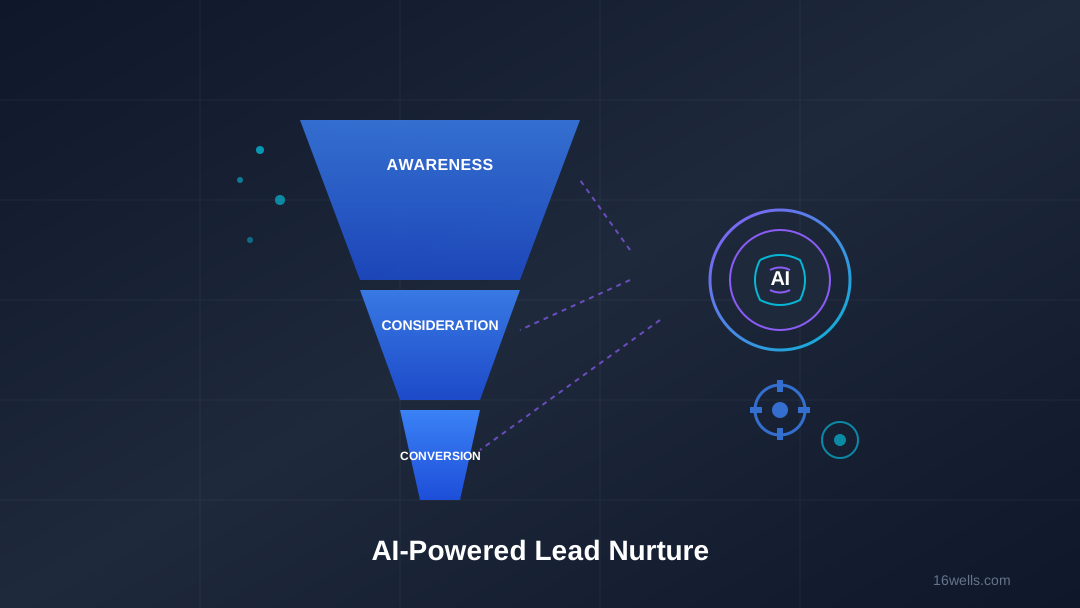
The Long Road to Conversion in Complex Sales
When someone signs up for a Netflix trial, they’re streaming content within minutes. When someone considers signing up for a financial services product, enterprise software, or B2B solution involving significant investment—that decision might take six months. Or longer.
This extended consideration period is one of the defining challenges of financial services and B2B marketing. Prospects research extensively. They compare competitors. They wait for the “right time.” They get distracted by life. And somewhere in that journey, most of them go cold.
Traditional nurture sequences—a series of pre-written emails sent at fixed intervals—were designed for simpler purchase decisions. They don’t account for where a prospect actually is in their decision process. They can’t detect when someone is actively researching versus passively subscribed. They treat every lead the same way.
AI changes this equation fundamentally. With the right systems in place, you can now build nurture programs that adapt in real-time to individual behavior, predict when prospects are ready to convert, and deliver personalized experiences that feel less like marketing and more like helpful guidance.
Understanding the High-Consideration Journey
Before building any system, you need to understand what makes complex purchase decisions different. The journey typically includes distinct phases that don’t follow a linear path.
The Awareness Spark
Something triggers initial interest—a market event, a recommendation from a colleague, frustration with a current solution, or simply reaching a point where the status quo becomes unacceptable. At this point, the prospect is gathering basic information and isn’t ready for sales pressure.
The Research Phase
Active comparison begins. The prospect visits multiple websites, reads reviews, watches videos, and forms preliminary opinions. They might sign up for newsletters from several competitors. This phase can last weeks or months.
The Consideration Pause
Many prospects hit a plateau. They’ve gathered information but haven’t decided. Life intervenes. They’re waiting for budget approval, more time, or more confidence. Traditional nurture sequences often lose people here because they continue sending the same cadence regardless of this stall.
The Activation Moment
Something reignites interest—a business opportunity, a promotion, a change in circumstances, or simply the right message at the right time. Prospects who re-engage at this point often convert quickly if you can identify and respond to the moment.
The Decision Point
Final evaluation and commitment. The prospect needs reassurance, answers to specific questions, and confidence in their choice. This is where personalized, relevant communication makes the difference between conversion and abandonment.
Building Your AI-Powered Foundation
An effective AI nurture system requires four core components working together: data collection, behavioral analysis, content personalization, and delivery optimization.
Comprehensive Data Collection
AI systems are only as good as their data inputs. For complex sales nurture, you need to capture:
Engagement signals: Email opens and clicks, website visits and page depth, content downloads, video watch time, webinar attendance, and social media interactions. Each of these tells you something about interest level and topic preferences.
Behavioral patterns: Time of day activity occurs, frequency of engagement, device preferences, and session duration. Someone who visits your pricing page at 2 AM might be in a different mindset than someone browsing during lunch.
Intent indicators: Comparison page visits, FAQ page time, demo requests, feature-specific research, and return visits after periods of inactivity. These signals suggest where someone is in their decision journey.
External data: Market conditions, industry news, seasonal patterns, and economic indicators that might influence purchase timing. AI can correlate your engagement data with external factors to predict optimal outreach moments.
Behavioral Analysis Engine
Raw data becomes valuable when AI identifies patterns. Your analysis engine should focus on:
Engagement scoring: Not just counting actions but weighting them by recency, frequency, and relevance. A pricing page visit yesterday is more significant than a blog read three months ago.
Journey stage identification: Using behavioral clusters to estimate where each prospect is in their consideration process. AI can identify patterns that indicate research mode versus decision mode versus dormancy.
Propensity modeling: Predicting likelihood to convert based on behavioral similarities to past converters. This helps prioritize resources and timing.
Churn prediction: Identifying when prospects are losing interest so you can intervene before they go completely cold.
Designing Behavioral Triggers
The magic of AI nurture systems lies in triggers—specific behaviors or conditions that initiate personalized responses. Well-designed triggers feel helpful rather than intrusive.
High-Intent Triggers
These behaviors suggest someone is actively evaluating and may be close to a decision:
Pricing page revisit: When someone returns to your pricing page multiple times within a short period, they’re likely comparing options. Trigger: Send a comparison guide or offer a consultation to answer questions.
Feature deep-dive: Extended time on specific feature pages or repeated visits to the same functionality areas. Trigger: Send detailed content about that feature, including use cases and success stories.
Demo completion: Watching a full product demo or completing an interactive tour. Trigger: Follow up with next steps, offer a live walkthrough, or provide trial access.
Return from dormancy: Re-engagement after 30+ days of inactivity, especially if they go directly to high-value pages. Trigger: Welcome back messaging that acknowledges the gap and offers fresh value.
Nurture Maintenance Triggers
These keep prospects engaged during the long consideration period:
Content consumption patterns: When someone consistently engages with educational content but hasn’t moved toward evaluation. Trigger: Gradually introduce more product-oriented content mixed with education.
Industry events: Significant industry developments or news in areas the prospect has shown interest. Trigger: Commentary or analysis that demonstrates your solution’s relevance to current conditions.
Milestone timers: Time-based triggers that check engagement levels and adjust approach. If someone hasn’t engaged in two weeks, trigger a re-engagement campaign before they go fully cold.
Peer activity: When similar prospects (same industry, role, or behavior pattern) are converting at higher rates. Trigger: Social proof content or limited-time offers that create urgency.
Risk Mitigation Triggers
These prevent prospects from falling through the cracks:
Declining engagement: Decreasing open rates, fewer visits, or shorter sessions. Trigger: Change the approach—different content types, adjusted frequency, or direct outreach asking for feedback.
Competitor signals: If you can identify when prospects are actively researching competitors (through content topics or referral sources). Trigger: Differentiation content that addresses common switching considerations.
Stalled applications: Started but incomplete signup or application processes. Trigger: Supportive follow-up that addresses common obstacles without being pushy.
Lead Scoring That Actually Works
Traditional lead scoring assigns points to actions—10 points for an email open, 50 points for a demo request—and passes leads to sales when they hit a threshold. This approach has significant limitations for high-consideration products.
Multi-Dimensional Scoring
AI enables more sophisticated scoring models that consider multiple factors simultaneously:
Engagement score: How actively is this person interacting with your content and brand? This measures volume and recency of interactions.
Fit score: How well does this prospect match your ideal customer profile? Consider account size potential, experience level, and solution compatibility.
Intent score: Based on behavioral patterns, how close is this person to making a decision? This is the most valuable and most difficult metric to calculate.
Timing score: Based on external factors and individual patterns, is this a good moment to intensify outreach? Market conditions, seasonal patterns, and personal engagement rhythms all factor in.
Dynamic Score Adjustment
Static scores decay quickly. AI systems should continuously adjust based on:
Recency weighting: Recent actions count more than historical ones. An engaged prospect from six months ago who’s gone silent isn’t as valuable as a new prospect showing strong initial interest.
Velocity tracking: The rate of score change matters as much as the absolute number. A rapidly increasing score suggests momentum that should trigger faster response.
Pattern recognition: AI can identify when scoring patterns match historical converters or churners, adjusting predictions accordingly.
Score-Based Routing
Different score levels should trigger different treatments:
Low scores (nurture pool): Automated content delivery focused on education and brand building. Monitor for engagement increases.
Medium scores (active nurture): More personalized content, increased frequency, and introduction of conversion-oriented messaging.
High scores (sales-ready): Direct sales outreach, consultation offers, and accelerated paths to conversion.
Declining scores (re-engagement): Specific campaigns designed to rekindle interest or gracefully reduce communication frequency.
Personalized Sequence Architecture
With AI, you move from linear email sequences to dynamic content journeys that adapt based on individual behavior.
Content Modules Over Fixed Sequences
Instead of Sequence A (emails 1-10 in order), build content modules that AI can assemble based on prospect behavior:
Educational modules: Industry fundamentals, best practices, solution capabilities—delivered based on demonstrated knowledge level and interests.
Social proof modules: Case studies, testimonials, and success stories—matched to the prospect’s likely use case and concerns.
Objection handling modules: Content that addresses common concerns—triggered when behavior suggests specific objections (like pricing page visits without conversion).
Conversion modules: Direct calls-to-action, offers, and onboarding support—deployed when intent signals are strong.
Channel Orchestration
AI nurture systems should coordinate across channels rather than treating each independently:
Email remains the backbone: But frequency and content should adapt based on engagement with other channels.
Retargeting coordination: Display ads should reinforce email messaging without feeling redundant. AI can sequence these for maximum impact.
Website personalization: When known prospects visit your site, dynamically adjust content, CTAs, and offers based on their journey stage and interests.
Direct outreach triggers: Sales calls and personal emails should be timed based on AI signals, not arbitrary schedules.
Frequency Optimization
One of AI’s most valuable applications is determining optimal contact frequency for each individual:
Some prospects want daily industry updates. Others will unsubscribe after three emails in a week. AI can identify these preferences through engagement patterns and adjust accordingly.
Build rules that prevent over-communication while ensuring active prospects receive timely information. Consider engagement-based throttling—increase frequency for highly engaged prospects and decrease for those showing fatigue.
Implementation Roadmap
Building an AI nurture system is a significant undertaking. Here’s a phased approach that delivers value incrementally.
Phase 1: Foundation (Months 1-2)
Focus on data infrastructure and basic automation:
- Implement comprehensive tracking across all touchpoints
- Unify data in a single platform (CDP or marketing automation system with strong integration)
- Build basic lead scoring based on engagement metrics
- Create modular content library organized by topic and journey stage
- Set up simple behavioral triggers (pricing page visits, content downloads)
Phase 2: Intelligence (Months 3-4)
Add AI-powered analysis and personalization:
- Implement propensity modeling based on historical conversion data
- Build dynamic scoring that incorporates multiple dimensions
- Create automated journey stage identification
- Deploy content recommendation engine
- Establish A/B testing framework for continuous optimization
Phase 3: Optimization (Months 5-6)
Refine and expand capabilities:
- Implement send-time optimization based on individual patterns
- Add churn prediction and re-engagement automation
- Build cross-channel orchestration
- Create feedback loops between sales outcomes and marketing scoring
- Develop advanced triggers based on market conditions and external data
Phase 4: Scale (Ongoing)
Continuous improvement and expansion:
- Expand to new segments and products
- Implement more sophisticated personalization (dynamic content, AI-generated variations)
- Build predictive models for lifetime value and optimal customer profiles
- Create automated reporting and alerting for system performance
Measuring What Matters
AI nurture systems generate enormous amounts of data. Focus on metrics that actually indicate success:
Conversion Metrics
Journey compression: Are prospects moving from awareness to conversion faster? Track average time-to-conversion and compare to historical baselines.
Stage progression: What percentage of prospects move from one journey stage to the next? Identify where people stall and optimize accordingly.
Attribution accuracy: Can you identify which touchpoints actually influenced conversion? AI can help with multi-touch attribution that goes beyond last-click.
Engagement Metrics
Engagement retention: What percentage of leads remain engaged over time? Track cohorts to see if your nurture is maintaining interest during long consideration periods.
Content effectiveness: Which modules drive the most stage progression? Use this to optimize your content mix.
Channel efficiency: Which channels deliver the best engagement relative to cost? AI can optimize spend allocation across channels.
System Health Metrics
Scoring accuracy: Do high-scoring leads actually convert at higher rates? Regularly validate your scoring model against outcomes.
Trigger effectiveness: Do triggered communications outperform scheduled ones? Measure lift from behavioral triggers.
Personalization impact: Do personalized content paths outperform generic ones? Test continuously.
Common Pitfalls to Avoid
Having implemented these systems across multiple financial services and B2B clients, I’ve seen recurring mistakes:
Over-Engineering Early
Don’t try to build the perfect system before launching. Start with basic triggers and scoring, learn from real data, then add sophistication. A simple system that’s live beats a complex system that never launches.
Ignoring Sales Feedback
Marketing automation should connect to sales outcomes, not operate in isolation. Build feedback loops so sales can flag scoring accuracy issues and share qualitative insights about what’s working.
Content Starvation
AI can only work with the content you provide. Many companies build sophisticated triggers but don’t have enough quality content to serve different scenarios. Invest in content depth before scaling automation.
Compliance Shortcuts
Financial services nurture must comply with regulations. Ensure your AI systems include appropriate disclaimers, respect communication preferences, and maintain audit trails. Don’t let personalization cross into inappropriate territory.
Set-and-Forget Mentality
AI systems require ongoing attention. Models drift, content becomes stale, and market conditions change. Plan for continuous monitoring and optimization from the start.
Frequently Asked Questions
How long does it take to see results from an AI nurture system?
Initial improvements in engagement metrics often appear within 4-6 weeks of implementation. However, for high-consideration products with long sales cycles, meaningful conversion improvements typically take 3-6 months to materialize. The system needs time to learn from data and prospects need time to move through their journey. Plan for a 6-month evaluation period before making major strategic conclusions.
What’s the minimum database size needed for AI nurture to be effective?
Effective AI learning requires sufficient data volume. For basic personalization and scoring, you need at least 5,000-10,000 contacts with meaningful engagement history. For sophisticated propensity modeling, you typically need 500+ conversions to train accurate models. Smaller databases can still benefit from rule-based automation and simpler AI applications, then graduate to more sophisticated approaches as data accumulates.
How do we balance personalization with financial services compliance requirements?
Build compliance into your system architecture from the start. Create content modules that include required disclaimers. Implement approval workflows for any AI-generated or dynamically assembled content. Maintain audit trails of what was sent to whom and when. Work with your compliance team to establish guardrails for personalization—what can be customized and what must remain standardized. Most AI nurture personalization (timing, content selection, channel choice) doesn’t create compliance issues when the underlying content is pre-approved.
Should we build this in-house or use a vendor platform?
Most financial services companies should start with vendor platforms and customize rather than build from scratch. Platforms like HubSpot, Marketo, or Salesforce Marketing Cloud offer AI capabilities that would take years to develop internally. However, you may need custom integration work to connect these platforms with your specific data sources and internal systems. The build-vs-buy calculus shifts toward building only if you have very unique requirements or AI is a core competitive differentiator for your business.
How do we handle prospects who engage heavily but never convert?
These “forever researchers” are common in financial services and B2B sales. AI can help identify this pattern through engagement-to-conversion ratio analysis. Once identified, you have options: reduce investment in nurturing them (lower communication frequency, remove from paid retargeting), attempt to understand blockers (surveys, direct outreach asking what’s holding them back), or create low-friction entry points (free trials, limited features) that might eventually lead to full conversion. Don’t completely abandon them—some will convert eventually—but don’t let them consume resources disproportionate to their likely value.
What role should human salespeople play alongside AI nurture?
AI nurture should enhance human selling, not replace it. Use AI to identify the right moments for human outreach—when intent signals are strong, when specific questions arise, or when personal attention could accelerate conversion. Sales teams should review AI-generated insights about prospect interests and concerns before making calls. The handoff from automated nurture to human engagement should feel seamless to the prospect. Think of AI as doing the work of identifying who to call and arming salespeople with relevant context.
Key Takeaways
- High-consideration products need sophisticated nurture: Traditional linear email sequences can’t handle the complexity of 6+ month sales cycles with non-linear buyer journeys.
- Behavioral triggers beat scheduled sends: AI-powered triggers that respond to actual prospect behavior outperform time-based sequences by delivering relevant content at moments of peak interest.
- Multi-dimensional lead scoring matters: Move beyond simple point accumulation to scoring that considers engagement, fit, intent, and timing as separate dimensions.
- Build modular content libraries: Instead of fixed sequences, create content modules that AI can assemble into personalized journeys based on individual behavior and preferences.
- Implement in phases: Start with data foundation and basic triggers, add AI intelligence over time, and plan for continuous optimization rather than a one-time build.
- Measure journey compression: The key success metric is whether prospects move from awareness to conversion faster, not just whether individual emails perform well.
- Balance automation with human touch: Use AI to identify optimal moments for personal outreach and arm sales teams with insights, rather than trying to automate the entire journey.