
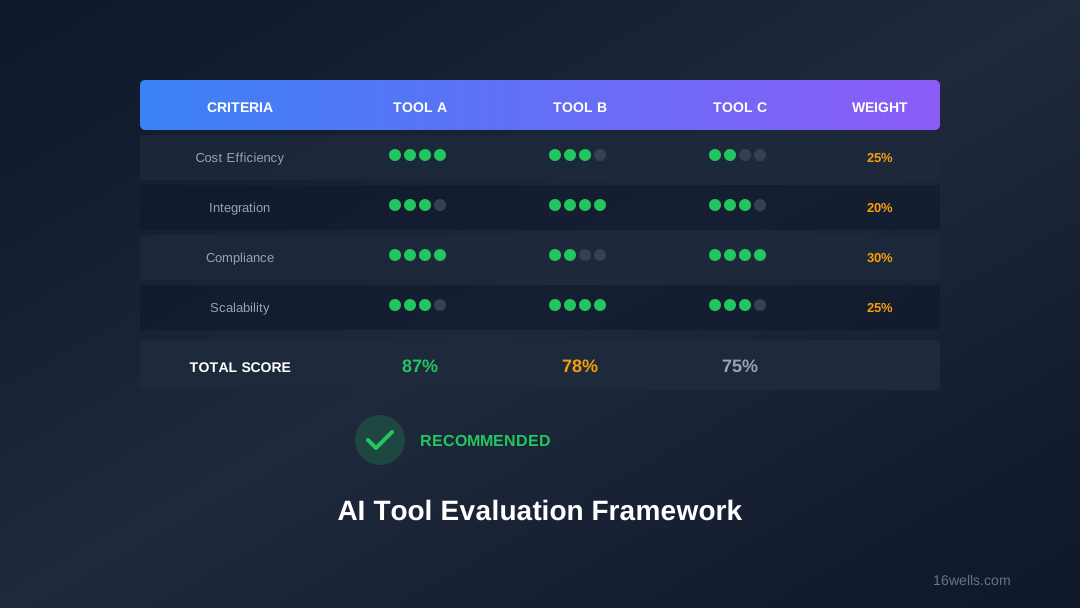
The AI Investment Challenge
Every marketing conference features AI prominently. Every vendor has added “AI-powered” to their pitch deck. Every competitor seems to be investing heavily in machine learning capabilities. The pressure to adopt AI tools is intense—but so are the budgets required and the risks of choosing poorly.
Marketers at financial services firms and data-driven businesses face unique challenges in this landscape. Industry compliance requirements mean many off-the-shelf AI solutions need significant customization. Data is often siloed across operational systems, CRM platforms, and marketing tools that don’t talk to each other easily. And customers expect a level of precision and trustworthiness that rules out many “move fast and break things” AI implementations.
After evaluating dozens of AI tools for financial services and B2B clients and implementing many of them, I’ve developed a framework for separating genuine value from expensive hype. This isn’t about being anti-AI—quite the opposite. It’s about investing AI budgets wisely to achieve real competitive advantage.
The Evaluation Framework
Before diving into specific tool categories, establish a consistent evaluation approach that works across all AI investments.
Start With the Problem, Not the Technology
The most common mistake in AI adoption is falling in love with a capability before confirming it solves an actual problem. Vendors are excellent at demonstrating impressive technology. They’re less focused on whether that technology addresses your specific challenges.
Before any evaluation, document:
- What specific business problem are we trying to solve?
- How are we solving it today, and what’s inadequate about that approach?
- What would success look like, quantified?
- Who would use this tool, and do they have the skills and time?
- What’s the cost of not solving this problem?
If you can’t answer these questions clearly, you’re not ready to evaluate tools. You’re shopping, not buying—and shopping is expensive when vendors invest time in demos and pilots.
The Four Dimensions of AI Tool Value
Evaluate every AI tool across four dimensions:
Automation value: Does it replace manual work that’s currently consuming human time? Calculate hours saved times fully-loaded labor cost. This is the easiest value to quantify and the most common AI benefit.
Quality improvement: Does it produce better outcomes than current methods? Better could mean higher conversion rates, lower error rates, or improved customer experience. Quantify by estimating the value of quality differences.
Speed advantage: Does it enable decisions or actions that couldn’t happen fast enough before? In fast-moving industries, timing can be everything. Value the competitive advantage of faster response.
Capability expansion: Does it enable things you simply couldn’t do before, regardless of time or effort? This is the hardest to value but often the most strategic. Consider what new opportunities become possible.
The True Cost Calculation
AI tools rarely cost only their sticker price. Build a comprehensive cost model:
Direct costs: License fees (often per-seat or usage-based), implementation and integration fees, training costs, and ongoing support contracts.
Hidden costs: Internal IT resources for integration, data preparation and cleaning, process redesign to accommodate new tools, change management and adoption support, and opportunity cost of the evaluation process itself.
Ongoing costs: Model retraining and maintenance, expanding usage as needs grow, version upgrades, and the cost of becoming dependent on a vendor.
A tool that costs $50,000 annually might require $150,000 in first-year integration work plus $30,000 in annual maintenance. Your ROI calculation must include all of this.
ROI Calculation Methods
Different AI applications require different ROI approaches. Here are frameworks for common financial services and B2B marketing use cases.
Content Generation ROI
AI content tools (for drafting emails, social posts, ad copy, etc.) offer relatively straightforward ROI calculation:
Time savings method: Estimate hours currently spent on content creation. Estimate percentage that AI can handle or accelerate. Calculate value of saved time. Factor in editing and review time that AI-generated content still requires.
Example: If your team spends 40 hours per week on content creation, AI reduces that by 50%, and fully-loaded cost is $75/hour, that’s $78,000 annual savings. Subtract the tool cost and any increase in review time.
Quality/volume tradeoff: Alternatively, if AI lets you produce more content without adding headcount, value the additional output. What would that extra content be worth in terms of reach, engagement, and conversion?
Caution for regulated industries: Compliance review requirements often eat into content generation savings. Don’t assume AI-generated content can bypass review processes. Factor realistic review time into your calculations.
Personalization ROI
AI personalization tools (for email content, website experience, ad targeting) require conversion-based ROI:
Lift-based calculation: Estimate current conversion rates for relevant funnels. Estimate realistic lift from personalization (vendors will quote best cases; discount significantly). Calculate incremental revenue from that lift. Subtract cost.
Example: Email generates $500,000 in annual revenue at 2% conversion. If AI personalization improves conversion to 2.5%, that’s $125,000 incremental revenue. But this assumes the lift is real and sustainable—get vendor references and run pilots before committing.
Test rigorously: Personalization vendors often cherry-pick success stories. Insist on A/B testing during pilots with your own data. Measure incremental lift against a control group, not just against historical performance.
Analytics and Insights ROI
AI analytics tools (predictive modeling, customer insights, attribution) have softer ROI but real value:
Decision improvement value: Identify specific decisions that would be improved by better insights. Estimate the value of making better decisions—usually through reduced waste, better targeting, or faster optimization.
Example: If AI attribution helps you reallocate $1 million in ad spend from 2x ROI channels to 4x ROI channels, that’s $2 million in incremental value. But this requires the attribution model to be accurate and actionable.
Speed value: If insights arrive faster, decisions improve. Value the time advantage in competitive markets.
Automation and Workflow ROI
AI workflow tools (campaign automation, lead scoring, content distribution) combine multiple value types:
Efficiency gains: Calculate time saved from automation. Include reduced errors and their costs.
Effectiveness gains: Measure improved outcomes from AI-optimized timing, targeting, or sequencing.
Scale enablement: Value the ability to do more without proportional cost increases.
Build vs. Buy Decision Framework
For larger AI initiatives, the question of building custom solutions versus buying vendor products is strategic. Here’s how to decide.
When to Buy
The problem is common: If many companies face the same challenge, vendors have likely built good solutions. Content generation, email optimization, and basic personalization fall into this category.
Speed matters more than differentiation: If you need capabilities quickly and they won’t be a competitive differentiator, buy and customize rather than building from scratch.
You lack AI expertise: Building AI systems requires specialized skills. If you don’t have them in-house and can’t justify hiring, vendor solutions with their expertise baked in make sense.
The data requirements are standard: If a tool can work with commonly available data (website analytics, email engagement, CRM data), buying is often easier than building.
When to Build
Your data is unique: If your competitive advantage comes from proprietary data—customer behavior patterns specific to your platform, unique market insights—custom AI that leverages this data can create defensible differentiation.
Compliance requires customization beyond vendor flexibility: If your regulatory environment demands controls that vendors can’t accommodate, building may be necessary.
Integration complexity is extreme: If connecting vendor tools to your existing systems would require more effort than building custom solutions, building might make sense.
AI is core to your strategy: If AI capabilities will be a primary competitive differentiator, investing in proprietary systems may be worthwhile despite higher costs.
The Hybrid Approach
Often the best answer is neither pure build nor pure buy:
Buy the platform, build the models: Use vendor infrastructure for data management and deployment, but train models on your proprietary data.
Buy for basics, build for differentiation: Use off-the-shelf tools for common needs and invest in custom development only where it creates unique value.
Start with buy, migrate to build: Learn from vendor implementations what works, then build custom versions of the highest-value capabilities as you develop expertise.
Red Flags and Hype Indicators
After years of vendor evaluations, certain patterns reliably indicate hype over substance.
Technology-First Pitches
If a vendor spends more time explaining their neural network architecture than how their tool solves your problems, be skeptical. Great AI tools focus on outcomes, not algorithms. The best vendors barely mention AI in their pitches—they talk about results.
Unrealistic Performance Claims
Claims like “300% improvement in conversion rates” are almost always based on cherry-picked scenarios, unrepresentative tests, or comparisons to deliberately weak baselines. Ask for:
- Median results across all customers, not best cases
- Results from customers similar to you in size, industry, and data maturity
- Methodology behind the measurements
- Time to achieve results, not just final outcomes
Black Box Resistance
If a vendor can’t explain how their AI makes decisions or refuses to provide transparency into model behavior, proceed with caution. In regulated industries, you may need to explain to regulators why certain marketing decisions were made. “The AI decided” isn’t an acceptable answer.
Data Requirements Mismatch
AI tools need appropriate data to function. If a tool requires millions of data points and you have thousands, it won’t perform as promised. Ask vendors:
- What’s the minimum data requirement for their tool to function?
- What’s the data requirement for optimal performance?
- How does performance degrade with less data?
- What happens during the cold-start period before enough data accumulates?
Integration Handwaving
Vendors often demonstrate tools in isolation, glossing over integration requirements. Probe deeply on:
- What systems does the tool need to connect to?
- What’s the typical integration timeline for companies like yours?
- What internal resources are required?
- What happens if your systems don’t have standard APIs?
Missing Industry Experience
Generic AI tools often struggle with industry-specific requirements. If a vendor has no financial services or B2B customers, expect compliance gaps, inappropriate content suggestions, and misunderstanding of your audience. Their AI was trained on different contexts.
Category-Specific Evaluation Questions
Different AI tool categories warrant different evaluation focuses.
Content Generation Tools
Key questions to ask:
- How do you handle compliance-sensitive content? Can we set guardrails?
- How does the tool learn our brand voice versus producing generic content?
- What’s the typical editing requirement for generated content?
- How do you handle required disclaimers and disclosures?
- Can we integrate our compliance review workflow?
- What happens when the model generates incorrect information?
Pilot approach: Generate content for actual campaigns and measure editing time, compliance issues, and quality scores compared to human-written alternatives.
Personalization Platforms
Key questions to ask:
- What data sources can you ingest, and how?
- How do you handle our specific customer segments?
- What’s the lift you’ve achieved for similar companies?
- How do you handle privacy regulations and consent management?
- Can we A/B test personalization against control groups?
- How long until the system is fully optimized with our data?
Pilot approach: Run controlled tests comparing personalized versus non-personalized experiences, measuring conversion lift and customer feedback.
Predictive Analytics Tools
Key questions to ask:
- What are you predicting, and how is that prediction actionable?
- What’s the accuracy of your predictions with similar customer data?
- How do you handle market volatility affecting customer behavior?
- Can we see the factors driving predictions (explainability)?
- How often do models need retraining, and what’s involved?
- What’s the minimum data history required for accurate predictions?
Pilot approach: Make predictions on historical data where you know the outcomes, measuring accuracy before deploying for live decisions.
Chatbots and Conversational AI
Key questions to ask:
- How do you prevent the bot from giving inappropriate advice?
- What’s the escalation path to human agents, and how smooth is it?
- How do you handle sensitive or compliance-related questions?
- What compliance logging and audit trails are available?
- Can we customize responses for different customer segments?
- What’s the customer satisfaction score for bot interactions versus human?
Pilot approach: Deploy with a subset of traffic and measure resolution rates, escalation rates, customer satisfaction, and compliance incidents.
Attribution and Measurement Tools
Key questions to ask:
- How do you handle the long consideration cycles typical in B2B and financial services?
- Can you incorporate offline conversions and multi-device journeys?
- How do you handle the decline of third-party cookies and tracking limitations?
- What’s your methodology for attributing value to touchpoints?
- Can we validate your attribution against known outcomes?
- How do you handle marketing to existing customers versus acquisition?
Pilot approach: Run attribution analysis on historical data and compare recommendations to what you actually did—would following the model’s recommendations have improved results?
The Evaluation Process
A structured evaluation process prevents both analysis paralysis and premature commitment.
Phase 1: Problem Definition (1-2 weeks)
Document the specific problem you’re solving. Quantify current state and desired state. Define success metrics. Get stakeholder alignment on priorities and constraints. Don’t start vendor conversations until this is complete.
Phase 2: Market Scan (2-3 weeks)
Identify potential solutions—vendors, build options, hybrid approaches. Request initial information without committing to full evaluations. Create a shortlist of 3-5 options that warrant deeper investigation.
Phase 3: Deep Evaluation (4-6 weeks)
For shortlisted options:
- Conduct detailed demos with realistic use cases
- Request and check references from similar companies
- Review security and compliance documentation
- Get detailed pricing for your specific situation
- Assess integration requirements with your IT team
Phase 4: Pilot/Proof of Concept (4-8 weeks)
Before committing to full implementation, run a limited pilot with the leading candidate. Define clear success criteria before starting. Use real data and realistic scenarios. Involve the people who will actually use the tool day-to-day.
Phase 5: Decision and Negotiation (2-3 weeks)
Based on pilot results, make a go/no-go decision. If proceeding, negotiate terms—many AI vendors have significant pricing flexibility, especially for multi-year commitments. Ensure contracts include performance guarantees and exit provisions.
Building Internal AI Evaluation Capability
Rather than approaching each AI evaluation from scratch, build organizational capability.
Develop AI Literacy
You don’t need everyone to become a data scientist, but marketing leaders should understand basic AI concepts:
- Difference between rules-based automation and machine learning
- How training data affects model performance
- Common AI limitations and failure modes
- Data requirements for different AI applications
Create Evaluation Templates
Standardize your evaluation process with templates for:
- Problem definition documents
- Vendor evaluation scorecards
- ROI calculation worksheets
- Pilot success criteria
- Post-implementation review frameworks
Establish a Review Board
For significant AI investments, create a cross-functional review board including marketing, IT, compliance, and finance. This prevents siloed decisions and ensures all perspectives are considered.
Learn from Every Implementation
Document lessons learned from both successful and failed AI implementations. What did you underestimate? What worked better than expected? Build organizational memory that improves future evaluations.
The Long-Term View
AI in marketing is evolving rapidly. Today’s leading tools may be obsolete in three years. Build your evaluation framework with this in mind:
Avoid vendor lock-in where possible: Prefer tools that work with standard data formats and don’t trap your data. Ensure you can export everything if you switch.
Invest in data infrastructure: Clean, accessible data is the foundation of all AI success. Investments in data infrastructure pay off across every AI tool you implement.
Build internal skills: Even if you buy rather than build, internal expertise improves your ability to evaluate, implement, and optimize AI tools. Hire or develop AI-literate marketers.
Stay current but skeptical: The AI landscape changes quickly. Stay informed about new developments, but apply rigorous evaluation to every shiny new tool. Most won’t live up to their hype.
Frequently Asked Questions
What’s a reasonable budget allocation for AI marketing tools?
As a rough benchmark, leading marketing teams allocate 10-15% of their marketing technology budget to AI-specific tools, separate from AI capabilities embedded in existing platforms. However, this varies significantly based on company size, data maturity, and strategic priorities. Start smaller with pilot projects, prove ROI, then expand investment. It’s better to fully implement and optimize one AI tool than to partially deploy five.
How do we get buy-in from skeptical executives for AI investments?
Focus on business outcomes, not technology. Translate AI capabilities into concrete improvements: “This tool will reduce our cost per lead by 20%” rather than “This uses advanced machine learning.” Start with pilot projects that can demonstrate quick wins. Show ROI from initial investments before requesting larger budgets. Address concerns about risk and compliance directly with specific controls. Bring case studies from comparable companies when possible.
Should we wait for AI tools to mature before investing, or move now?
The right answer is selective early adoption. Some AI applications—like basic content assistance and email optimization—are mature enough for confident investment now. Others—like fully autonomous campaign management or AI-generated compliance-approved content—need more development. Identify tools where the risk-reward ratio makes sense today. Meanwhile, build data infrastructure and internal capabilities that will help you adopt more advanced tools as they mature. Waiting for perfection means falling behind competitors who are learning and improving through implementation.
How do we evaluate AI tools when we don’t have AI expertise in-house?
Several approaches help: First, rely more heavily on pilot projects—you don’t need to understand the algorithm to measure whether it delivers results. Second, engage consultants for technical evaluation of finalist vendors. Third, lean on vendor references—talk to similar companies about their experience. Fourth, ask vendors to explain their technology in business terms; if they can’t, that’s a red flag. Finally, start building internal expertise through training and potentially hiring—you’ll need it as AI becomes more central to marketing.
What happens when an AI tool doesn’t deliver promised results?
This is common, which is why pilots are essential before full commitment. If a tool underperforms during pilot, first diagnose whether it’s a data issue, implementation issue, or fundamental tool limitation. Work with the vendor to optimize—they should want to prove their tool works. If performance doesn’t improve, exit the pilot without further investment. For tools already in production that disappoint, document the gap between promises and reality, attempt optimization, and if that fails, develop an exit plan. Negotiate contracts that allow termination if performance benchmarks aren’t met.
How do we handle compliance review of AI-generated content?
AI should accelerate content creation, not bypass compliance. Establish clear workflows where AI-generated content goes through the same review process as human-written content. Train compliance teams on AI capabilities and limitations so they know what to watch for. Some companies implement a pre-approved content library that AI can customize within boundaries—this reduces review burden while maintaining control. Document your AI content processes for regulatory examinations. Never assume AI-generated content is compliant simply because a vendor claims their tool is “compliance-aware.”
Key Takeaways
- Start with problems, not technology: Define the specific business problem you’re solving before evaluating any AI tool. If you can’t quantify the problem, you can’t calculate ROI.
- Calculate total cost of ownership: AI tools cost far more than their license fees. Include integration, training, maintenance, and internal resources in your ROI calculations.
- Evaluate across four dimensions: Assess automation value, quality improvement, speed advantage, and capability expansion separately. Different tools deliver different types of value.
- Watch for red flags: Technology-first pitches, unrealistic performance claims, black box resistance, and missing industry experience all indicate potential problems.
- Pilot before committing: Run controlled tests with your own data and realistic use cases before making significant investments. Vendor demos aren’t proof of performance.
- Build evaluation capability: Create standardized processes, templates, and organizational knowledge that improve over time. Each evaluation should be better than the last.
- Plan for evolution: The AI landscape changes rapidly. Avoid vendor lock-in, invest in data infrastructure, and build skills that transfer across tools.