
Reading Time: 16 minutes
The Content Paradox in Regulated Industries
Financial services and B2B companies need more content than almost any other industry. Customers want regular analysis and insights. Prospects need educational materials. Clients expect regular communication. Search engines reward fresh, authoritative content. Social media demands constant engagement.
At the same time, financial services has the tightest constraints on content. Everything must be accurate. Claims need substantiation. Disclosures are mandatory. Regulatory review is non-negotiable. One wrong statement can trigger compliance violations, client complaints, or regulatory action.
This creates a paradox: you need high volume, but every piece requires careful oversight. The traditional solution—hire more writers and compliance reviewers—is expensive and slow. It doesn’t scale.
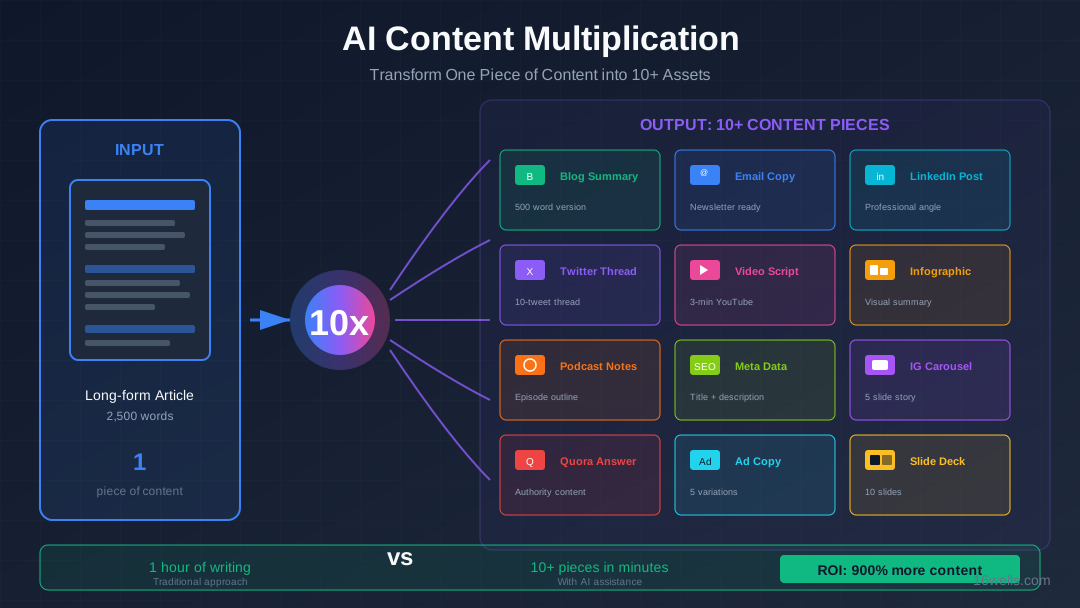
AI offers a different path. Not by replacing human judgment, but by dramatically accelerating the parts of content creation that don’t require expert oversight. The result: 10x content output with the same team and the same compliance standards.
Here’s exactly how to build that system.
The Compliance-First AI Content Framework
Most content AI implementations fail in regulated industries because they treat compliance as an afterthought—something to check at the end. That’s backwards. Compliance needs to be built into the AI workflow from the beginning.
Principle 1: Constrain AI at Input, Not Just Output
Rather than letting AI write whatever it wants and then editing for compliance, tell AI upfront what it cannot do. Build compliance guardrails into your prompts and system instructions.
Principle 2: AI Drafts, Humans Finalize
AI is a drafting tool, never a publishing tool. Every piece of content requires human review before publication. The question is how much human review—and we’ll cover that below.
Principle 3: Standardize, Then Scale
Before using AI to produce more content, standardize your content templates, approved language libraries, and review checklists. AI scales whatever you give it—including inconsistencies and errors.
Principle 4: Build Audit Trails
Document the AI involvement in every piece of content. This protects you in regulatory reviews and helps you trace issues back to their source.
Building Your Compliant AI Prompt Library
The foundation of compliant AI content is well-designed prompts that prevent problematic outputs before they happen. Here’s how to build them:
Step 1: Document What’s Not Allowed
Work with your compliance team to create an explicit list of prohibited content types:
- Performance predictions or guarantees
- Specific return claims without proper disclosure
- Comparative claims without substantiation
- Testimonials without required disclaimers
- Investment advice for specific situations
- Promises of outcomes
- Urgency or scarcity tactics that cross ethical lines
This list becomes the foundation of your AI guardrails.
Step 2: Create a Master System Prompt
Every AI interaction should start with a system prompt that establishes compliance boundaries. Here’s a template:
You are a content assistant for a financial services or B2B company. You help draft
educational and marketing content.

CRITICAL COMPLIANCE REQUIREMENTS:
- Never make specific performance predictions or guarantees
- Never provide personalized advice that crosses compliance boundaries
- Never make claims about results without appropriate disclaimers
- Never use urgency tactics like "act now" or "limited time"
- Always maintain an educational, informational tone
- When discussing products or strategies, include appropriate risk disclosures
- Never compare performance to competitors without explicit instruction
  and substantiation

If asked to create content that would violate these requirements, decline
and explain why.

You are creating DRAFTS that will be reviewed by compliance before publication.
Customize this for your specific regulatory environment and business type.
Step 3: Build Content-Type Templates
Create prompt templates for each content type you produce regularly:
Market Commentary Template:
Create a market commentary for [date] covering:
- Key market movements: [specific data points]
- Notable events: [specific events]
- Sector performance: [specific sectors]

Requirements:
- Educational tone, not advisory
- No predictions about future performance
- Include standard disclosure: "This commentary is for informational
  purposes only and does not constitute investment advice."
- Approximately [word count] words
Educational Article Template:
Create an educational article about [topic].

Target audience: [beginner/intermediate/advanced] customers who want to
understand [specific concept].

Key points to cover:
1. [Point 1]
2. [Point 2]
3. [Point 3]

Requirements:
- Explain concepts clearly without recommending specific actions
- Include risk disclosures where appropriate
- Use examples that illustrate concepts without constituting advice
- Approximately [word count] words
Step 4: Establish Approved Language Libraries
Create repositories of pre-approved phrases for common situations:
- Risk disclosures: 5-10 approved versions for different contexts
- Performance language: Approved ways to discuss historical returns
- Call-to-action phrases: Compliance-approved CTAs
- Competitive positioning: How to discuss advantages without problematic claims
Reference these in your prompts: “Use approved risk disclosure #3” or “End with approved CTA #2.”
The Three-Tier Review Process
Not all content requires the same level of review. Establish tiers based on risk:
Tier 1: Light Review (15-30 minutes)
Content types: Internal summaries, social media posts about general topics, email subject line tests, basic blog posts about educational concepts
Review process:
- Automated grammar and style check
- Quick compliance keyword scan
- Single reviewer approval
AI involvement: AI can generate near-final drafts; human edits are minor
Tier 2: Standard Review (1-2 hours)
Content types: Blog posts with market references, email campaigns, landing page copy, webinar descriptions, detailed educational content
Review process:
- Subject matter expert review for accuracy
- Compliance review for regulatory issues
- Editorial review for quality and voice
- Two-person sign-off
AI involvement: AI generates first drafts; humans provide significant editing
Tier 3: Full Review (2-4 hours)
Content types: Advertising copy, performance claims, testimonials, product descriptions, disclosures, anything client-facing about specific products
Review process:
- Legal review
- Compliance review with documentation
- Executive sign-off
- Archival in compliance records
AI involvement: AI may assist with drafting, but humans rewrite substantially; AI more useful for formatting and variations
Quality Control Checkpoints
Build quality control into your workflow at multiple stages:
Checkpoint 1: Pre-Generation
Before AI creates content:
- Verify the content type is appropriate for AI assistance
- Confirm the prompt includes all compliance requirements
- Check that source materials are accurate and current
- Identify the review tier this content requires
Checkpoint 2: Post-Generation
Immediately after AI creates content:
- Scan for prohibited phrases (performance guarantees, specific advice)
- Verify all factual claims against source materials
- Check for AI hallucinations (made-up statistics, incorrect dates)
- Ensure required disclosures are present
Checkpoint 3: Expert Review
Before compliance submission:
- Subject matter expert verifies accuracy
- Editor ensures voice and quality standards
- Compliance checklist completed
Checkpoint 4: Final Approval
Before publication:
- Compliance sign-off documented
- Publication metadata recorded (date, version, approvers)
- Archive copy saved for records
The 10x Content Workflow in Practice
Here’s how a 10x AI content workflow actually operates for a B2B services company:
Weekly Industry Commentary: From 3 Hours to 30 Minutes
Before AI:
- Expert gathers data and insights (30 min)
- Expert writes commentary (2 hours)
- Review and approval (30 min)
- Total: 3 hours, 1 piece of content
After AI:
- Expert gathers data and insights (20 min)
- Expert feeds data to AI with structured prompt (5 min)
- AI generates draft (1 min)
- Expert reviews and refines (15 min)
- Review and approval (15 min)
- Total: ~55 minutes, with time to create variations
Net result: Same quality, 3x faster. Use saved time for deeper analysis or additional content.
Weekly Blog Posts: From 2 Posts to 8 Posts
Before AI:
- Writer produces 2 blog posts per week (6-8 hours each)
- Each goes through editorial and compliance review
- Total: 16 hours for 2 posts
After AI:
- Writer outlines 8 posts (2 hours total)
- AI generates drafts from outlines (20 min total)
- Writer refines and adds expertise (1 hour each, 8 hours total)
- Editorial and compliance review (30 min each, 4 hours total)
- Total: ~14 hours for 8 posts
Net result: 4x content volume with less total time.
Email Campaigns: From 1 Version to 10 Versions
Before AI:
- Marketer writes one email version (2 hours)
- Compliance review (30 min)
- Total: 2.5 hours for 1 version
After AI:
- Marketer writes one email version (1.5 hours)
- AI generates 9 variations with different angles (15 min)
- Marketer reviews and selects best 5 (30 min)
- Compliance reviews all 5 (45 min with batch processing)
- Total: ~3 hours for 5 testable versions
Net result: 5x testing capacity with minimal time increase.
Common Pitfalls and How to Avoid Them
Pitfall 1: AI Hallucinations
The problem: AI confidently states incorrect facts—made-up statistics, wrong dates, nonexistent studies.
The solution: Never trust AI for factual claims. Provide source materials in your prompts and require AI to work from them. Verify every statistic, date, and external reference before publication.
Pitfall 2: Compliance Creep
The problem: AI gradually introduces problematic language that seems fine in isolation but creates compliance issues in context.
The solution: Regular audits of AI-generated content. Review a random sample monthly against your compliance checklist. Look for patterns in what slips through.
Pitfall 3: Voice Drift
The problem: AI content sounds increasingly generic and loses your brand’s distinctive voice.
The solution: Include brand voice guidelines in your system prompts. Provide examples of your best content for AI to reference. Have human editors specifically review for voice, not just accuracy.
Pitfall 4: Over-Reliance
The problem: Teams become dependent on AI and lose the ability to create content without it.
The solution: Maintain human content creation skills. Use AI to enhance output, not replace capability. Rotate who does AI-assisted vs. human-only content.
Pitfall 5: Skipping Reviews Under Pressure
The problem: When content is faster to produce, teams feel pressure to skip review steps.
The solution: Build review into your publishing system. Content can’t go live without documented sign-off. Make compliance review a gate, not an option.
Measuring Success
Track these metrics to evaluate your AI content system:
Productivity Metrics
- Content volume: Pieces published per week/month
- Time per piece: Average hours from ideation to publication
- Cost per piece: Total labor cost divided by pieces produced
- Team capacity: Maximum sustainable output
Quality Metrics
- Error rate: Corrections needed post-publication
- Compliance issues: Items flagged in review
- Engagement: Read rates, time on page, shares
- Conversion: Content attribution to leads and sales
Efficiency Metrics
- Draft-to-publish ratio: What percentage of AI drafts become published content?
- Review time: Hours spent in compliance review
- Revision cycles: Average number of revisions before approval
Target Benchmarks
After implementing AI content workflows, target:
- 3-5x increase in content volume within 6 months
- 40-60% reduction in time per piece
- No increase in compliance issues (same or lower error rate)
- Equal or better engagement metrics
Implementation Roadmap
Weeks 1-2: Foundation
- Document compliance requirements with legal/compliance team
- Create prohibited content list
- Build master system prompt
- Establish review tiers for content types
Weeks 3-4: Pilot
- Select one content type for pilot (recommend: blog posts or email)
- Create content-specific prompt templates
- Train one team member on AI-assisted workflow
- Produce 5-10 pieces using new workflow
- Full compliance review of all pilot content
Weeks 5-8: Refinement
- Analyze pilot results (quality, time savings, issues)
- Refine prompts based on what worked/didn’t
- Build approved language libraries
- Document workflow for team training
Weeks 9-12: Expansion
- Train full content team on AI workflows
- Expand to additional content types
- Implement quality control checkpoints
- Establish ongoing audit process
Ongoing: Optimization
- Monthly review of AI content quality
- Quarterly prompt refinement
- Regular compliance audits
- Continuous training on new AI capabilities
FAQ: AI Content for Regulated Industries
Can AI-generated content be compliant in financial services?
Yes, if you implement proper controls. AI-generated content must go through the same compliance review as human-generated content. The key is building compliance requirements into your AI prompts and maintaining rigorous review processes. AI changes how content is drafted, not how it’s reviewed and approved.
How do we document AI involvement for regulators?
Maintain records of which content involved AI assistance, what prompts were used, who reviewed and approved the content, and the date of publication. Most compliance management systems can add fields for AI involvement. Treat AI like any other tool—document its use but focus accountability on the humans who approved publication.
What content types should we avoid using AI for?
Be cautious with content that includes specific investment recommendations, performance claims or projections, client-specific communications, legal disclosures and agreements, and crisis communications. AI can assist with drafting these, but human creation and review should be more intensive.
How do we handle AI errors that slip through review?
Have a correction protocol: acknowledge the error, correct it promptly, document what happened, and adjust your process to prevent recurrence. Track AI-related errors separately to identify patterns. If certain types of errors recur, modify your prompts or review checkpoints.
Should we disclose that content was AI-assisted?
Current regulations generally don’t require disclosure of AI assistance in content creation. However, the landscape is evolving. Document AI involvement internally regardless of disclosure requirements. Consider disclosure if your audience would find it material—transparency builds trust.
How do we train our compliance team to review AI content?
Train them to look for AI-specific issues: hallucinated facts, overly confident claims, subtle compliance boundary violations, and inconsistent voice. AI errors are different from human errors—compliance reviewers need to know what to look for. Share examples of AI mistakes to build pattern recognition.
Key Takeaways
- Build compliance into AI from the start. Create system prompts with explicit guardrails, not just review at the end.
- AI drafts, humans finalize. Every piece of content requires human review. AI is a drafting accelerator, not an autonomous publisher.
- Establish review tiers. Not all content needs the same review intensity. Match review depth to content risk.
- Implement quality checkpoints. Pre-generation, post-generation, expert review, and final approval each catch different issues.
- Target 3-5x content volume. Realistic outcome with maintained quality is 3-5x more content in the same time, not unlimited content.
- Watch for pitfalls: AI hallucinations, compliance creep, voice drift, over-reliance, and skipped reviews under pressure.
- Document everything. Maintain records of AI involvement, prompts used, and approval chain for regulatory protection.
- Start small, prove value, then scale. Pilot with one content type, refine your process, then expand.
Skip Shean is the founder of 16wells, helping financial services companies and data-driven B2B businesses implement AI-powered marketing that scales without sacrificing compliance. He’s developed AI content workflows for wealth managers, fintech companies, SaaS platforms, and professional services firms, balancing productivity gains with regulatory requirements.