
Reading Time: 15 minutes
The End of Marketing as You Know It
If your trading platform’s marketing strategy still depends on third-party cookies—those tracking mechanisms that follow users across the web—you’re building on a foundation that’s actively crumbling beneath you.
Google has been slowly phasing out third-party cookie support in Chrome, joining Safari and Firefox which blocked them years ago. When Chrome fully deprecates third-party cookies (delayed multiple times, but inevitable), approximately 85% of browser market share will no longer support the cross-site tracking that powers most retargeting, audience targeting, and attribution systems.
For financial services firms, this isn’t just a technical inconvenience. It’s an existential threat to your current marketing model. The platforms and strategies that drove your growth over the past decade simply won’t work the same way going forward.
The solution is first-party data—information that users provide directly to you, that you collect with their consent, and that you own and control. Building a robust first-party data strategy is how sophisticated financial services firms will maintain marketing effectiveness while the rest of the industry scrambles.
What Is First-Party Data and Why Does It Matter?
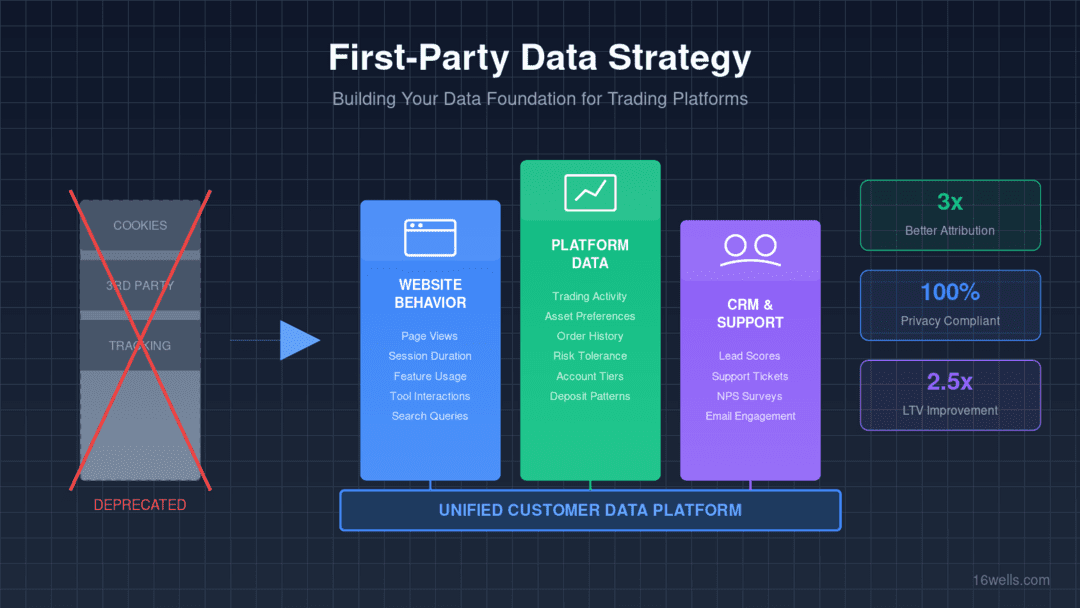
First-party data is information collected directly from your audience through your owned channels—your website, your app, your email list, your CRM, your trading platform. It includes both explicit data (information users provide directly, like name, email, trading preferences) and implicit data (behavioral signals like pages visited, content consumed, features used).
The distinction from third-party data is crucial:
Third-party data is collected by someone else (data brokers, ad networks, social platforms) through tracking technologies that follow users across multiple websites. You license access to it. You don’t control it. And it’s disappearing.
First-party data is yours. Users gave it to you directly. You collected it with consent. You control how it’s used. And it’s becoming more valuable as third-party data becomes less available.
For trading platforms specifically, you’re sitting on a goldmine of first-party data that most businesses would envy. You know which products traders are interested in, what their risk tolerance looks like, how frequently they trade, what educational content they consume, and whether they’re profitable. This information is extraordinarily valuable for marketing—if you know how to use it.
The Four Pillars of First-Party Data Strategy
Pillar 1: Collection Infrastructure
Before you can use first-party data, you need to collect it systematically. This means instrumenting every touchpoint where users interact with your brand.
Website and app tracking forms the foundation. Implement a consent-aware analytics system (typically GA4 with proper consent mode configuration) that collects behavioral data while respecting user preferences. Track not just page views, but meaningful engagement signals: time spent on educational content, interaction with pricing pages, use of trading tools and calculators.
Authentication is critical. The more users you can identify—through account creation, email capture, or authenticated sessions—the richer your first-party data becomes. Anonymous visitors provide behavioral signals, but identified users allow you to build persistent profiles that connect behavior across sessions and devices.
Progressive profiling captures additional data over time without overwhelming users upfront. Instead of asking for 15 data points at registration, collect the essentials first, then gather additional information through natural interactions—onboarding surveys, preference settings, trading behavior analysis.
Form and survey optimization ensures you’re maximizing the data you collect at each interaction point. Every form is an opportunity to gather useful information, but every unnecessary field is friction that reduces completion rates. Balance is key.
Pillar 2: Data Organization and Unification
Collecting data is meaningless if it sits in disconnected silos. The real power of first-party data comes from unification—creating a single, coherent view of each customer across all touchpoints.
Customer Data Platforms (CDPs) have emerged as the infrastructure layer for this unification. Tools like Segment, mParticle, or built-in CDP functionality in platforms like Salesforce and HubSpot collect data from multiple sources, resolve identity across touchpoints, and create unified customer profiles.
For trading platforms, your CDP should connect website behavior with CRM records, account management systems, trading activity data, email engagement, and support interactions. When someone visits your site anonymously, browses options content, creates a demo account, converts to funded account, and becomes an active trader, that entire journey should be visible as a single, connected story.
Identity resolution is the technical challenge at the heart of unification. Users interact with you across multiple devices, browsers, and sessions. Connecting these fragments into coherent identities requires a combination of deterministic matching (using login credentials, email addresses, or customer IDs) and probabilistic matching (using device fingerprinting and behavioral patterns).
Financial services firms have an advantage here: account creation and authentication requirements mean you often have verified identity data that other industries lack. Use it.
Pillar 3: Activation Channels
Data sitting in a database doesn’t drive revenue. Activation means using your first-party data to improve marketing performance across channels.
Advertising platform integrations allow you to use first-party data for targeting and optimization. Both Google and Meta offer ways to upload customer lists (hashed for privacy) and create targeting audiences based on your data. This includes Custom Audiences (target existing customers or lookalikes), Enhanced Conversions (improve attribution by matching conversions to ad interactions), and Offline Conversion Import (pass backend conversion data to ad platforms).
Email and marketing automation is where first-party data shines brightest. Unlike advertising where you’re renting access to audiences, email lets you reach your audience directly. Rich first-party data enables sophisticated segmentation: send different nurture sequences to options traders versus futures traders, adjust messaging based on trading frequency, trigger campaigns based on account milestones.
Personalization engines use first-party data to customize website and app experiences in real-time. Show relevant products, surface appropriate educational content, adjust messaging based on where users are in their journey. The more you know about a user, the more relevant you can make their experience.
Pillar 4: Privacy and Compliance
First-party data is only valuable if it’s collected and used compliantly. In financial services, where regulatory scrutiny is already intense, this means going beyond the minimum requirements.
Consent management must be rigorous and documented. Implement a consent management platform (CMP) that gives users clear choices about data collection and respects those choices throughout your stack. This isn’t just about cookie banners—it’s about ensuring that downstream systems actually honor the preferences users set.
Data minimization means collecting only what you need and retaining it only as long as necessary. Regulators increasingly expect organizations to justify their data collection practices. “We might use it someday” isn’t a valid justification.
Security and access controls protect both you and your customers. First-party data is a valuable asset that attracts attackers. Implement appropriate security measures and limit access to those who genuinely need it.
Documentation and audit trails become critical when regulators ask questions. Know where your data comes from, how consent was obtained, and how it’s being used. If you can’t answer these questions, you have a compliance gap.
Implementation Roadmap
Building a first-party data strategy isn’t a single project—it’s an ongoing capability development. Here’s a phased approach:
Phase 1: Foundation (Months 1-3)
Start by auditing your current data landscape. What first-party data do you already have? Where is it stored? How is it connected (or not connected)? Identify the gaps and silos.
Implement basic tracking infrastructure if you haven’t already. Set up GA4 with proper consent mode, ensure your CRM is capturing key customer touchpoints, and establish the data flows between systems.
Establish consent management. Deploy a CMP that meets regulatory requirements and actually enforces user preferences throughout your stack.
Phase 2: Unification (Months 4-6)
Deploy a Customer Data Platform or build equivalent functionality. The goal is creating unified customer profiles that connect data across touchpoints.
Implement identity resolution to connect anonymous and authenticated sessions, cross-device behavior, and historical data.
Build initial activation use cases—typically starting with enhanced advertising integration and email segmentation.
Phase 3: Advanced Activation (Months 7-12)
Expand advertising integrations to include enhanced conversions, offline conversion import, and sophisticated audience strategies.
Implement personalization across web and email based on first-party data signals.
Build predictive models that use your first-party data to identify high-value prospects and optimize marketing allocation.
Phase 4: Optimization (Ongoing)
Continuously refine your data collection and activation strategies based on performance data. Test new use cases. Expand into new channels. As third-party data becomes less available, your first-party data advantage becomes more valuable.
Frequently Asked Questions
How is first-party data different from zero-party data?
Zero-party data is a subset of first-party data that users explicitly and intentionally share—like survey responses, stated preferences, or profile information. First-party data includes both this explicit data and implicit data you observe through user behavior (pages visited, features used, etc.). Both are valuable and should be part of your strategy.
What happens to my retargeting campaigns when third-party cookies go away?
Traditional pixel-based retargeting that follows users across the web will become largely ineffective. The alternative is first-party audience retargeting—using your own customer data uploaded to advertising platforms, or server-side tracking that maintains user identity through your infrastructure. Performance won’t be identical, but with proper first-party data infrastructure, you can maintain much of the functionality.
Do I need a Customer Data Platform (CDP)?
Not necessarily, but you need the functionality that CDPs provide: data collection, identity resolution, and activation. For smaller platforms, you might achieve this through careful integration of existing tools (CRM, analytics, marketing automation). For larger platforms with complex data landscapes, a dedicated CDP often makes sense. Evaluate based on your specific needs and existing infrastructure.
How does first-party data strategy work with compliance requirements in financial services?
First-party data, when properly collected with consent, is generally more compliant than third-party data because you control the collection process and can document consent. However, financial services firms must still comply with industry-specific regulations (like FINRA rules around customer communications) in addition to general privacy laws. Work with compliance to ensure your data practices meet all applicable requirements.
What’s the ROI of investing in first-party data infrastructure?
ROI varies based on current maturity and implementation scope. Common returns include 15-30% improvement in advertising efficiency from enhanced conversions and better targeting, 20-40% improvement in email performance from better segmentation, and avoidance of the 30-50% performance degradation that third-party-dependent strategies will experience as cookies disappear. For most platforms spending $500K+ annually on marketing, infrastructure investments pay back within 6-12 months.
How do I get started if I have limited technical resources?
Start with the fundamentals: ensure GA4 is properly configured, implement basic consent management, and establish connections between your CRM and marketing platforms. Many CDPs and integration tools offer implementation services that can accelerate deployment. Prioritize the highest-impact use cases first—typically enhanced advertising integrations and email segmentation.
Key Takeaways
The privacy landscape is shifting permanently. Third-party cookies, device IDs, and cross-site tracking are going away—not because of one browser or one regulation, but because of a fundamental societal shift toward privacy protection. Financial services firms that continue to depend on these mechanisms will find their marketing effectiveness degrading year over year.
First-party data is the path forward. It’s more valuable (because it’s specific to your customers), more durable (because you own it), and more compliant (because you control how it’s collected). Building the infrastructure to collect, organize, and activate first-party data isn’t just a nice-to-have—it’s the foundation of effective marketing in the privacy-first era.
The firms that invest now will have a significant advantage. While competitors struggle with degraded targeting and broken attribution, you’ll be operating with rich customer data that powers effective marketing. Start building your first-party data strategy today.guN