
Reading Time: 12 minutes
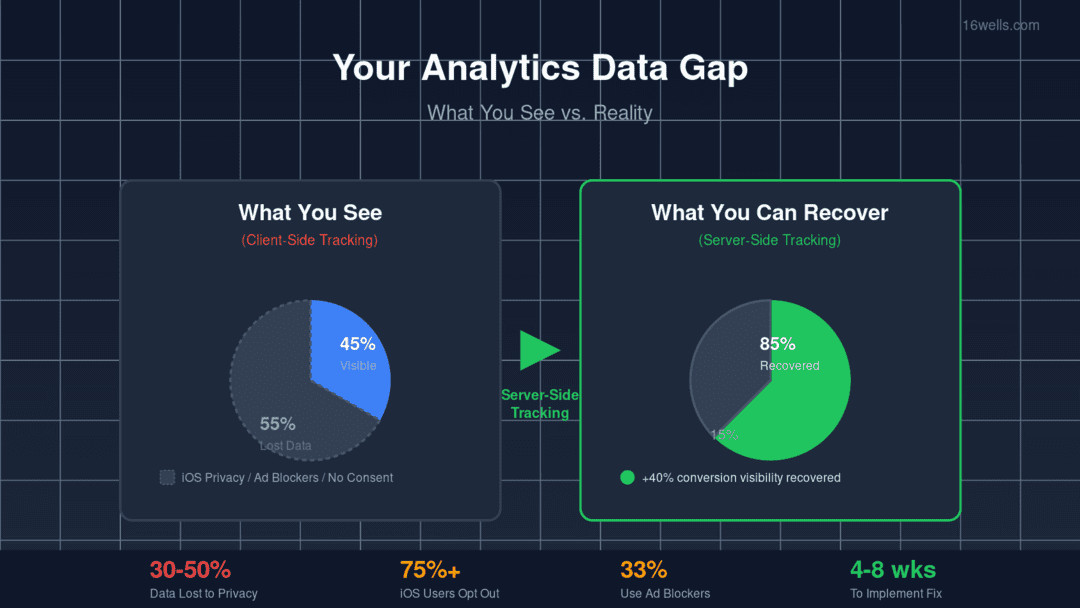
The Data Gap Crisis Hitting Trading Platforms
If you’re running marketing for an options, futures, or equity trading platform, here’s an uncomfortable truth: the numbers you’re seeing in Google Analytics, your Meta Ads dashboard, and your attribution reports are almost certainly wrong. Not a little wrong—potentially off by 30% to 50% or more.
This isn’t a minor inconvenience. For financial services firms where customer acquisition costs routinely run into the hundreds or thousands of dollars, and where lifetime value calculations drive everything from budget allocation to growth projections, inaccurate data is a business-critical problem.
The marketing analytics infrastructure that worked reasonably well five years ago has been systematically dismantled by three converging forces: Apple’s iOS privacy changes, the explosion of browser-based ad blockers, and increasingly aggressive consent management requirements. Each one chips away at your ability to track the customer journey from first touch to funded account.
Why Traditional Analytics Are Failing
Traditional web analytics relies on a simple concept: a small piece of JavaScript code (a “pixel” or “tag”) runs in your visitor’s browser and sends data back to platforms like Google Analytics, Meta, or your ad networks. This approach worked beautifully when browsers were cooperative, users were unaware, and privacy regulations were minimal.
That world no longer exists.
The iOS 14+ Privacy Earthquake
When Apple rolled out App Tracking Transparency (ATT) in iOS 14.5, it fundamentally changed how mobile tracking works. Users now must explicitly opt-in to tracking—and the vast majority don’t. According to data from Flurry Analytics, only about 25% of users opt in when asked.
For trading platforms, this is particularly painful because active traders skew heavily toward iPhone users. The very demographic you’re trying to reach is the one most likely to be invisible to your tracking.
Browser Ad Blockers at Scale
Ad blocking isn’t new, but its adoption has reached critical mass. According to Backlinko’s 2024 research, approximately 32.8% of internet users now run ad blockers. Among technically sophisticated audiences like active traders who spend their days analyzing charts and executing strategies, that percentage is considerably higher.
Ad blockers don’t just stop ads—they block the tracking scripts that collect your marketing data. Every blocked script is a conversion you can’t attribute, a customer journey you can’t see, and a marketing decision you’re making blind.
Consent Banners That Kill Tracking
GDPR, CCPA, and a growing patchwork of state privacy laws require consent before tracking. While compliance is non-negotiable, the practical effect is stark: a significant percentage of users either reject tracking outright or never interact with the consent banner at all. Either way, no data flows to your analytics platforms.
How Much Data Are You Actually Losing?
Let’s put concrete numbers on this problem. Consider a typical trading platform receiving 100,000 monthly website visitors:
Before the privacy apocalypse (2019):
- Trackable visitors: ~95,000 (95%)
- Conversions tracked: ~950 (assuming 1% conversion rate)
- Marketing attribution: Reasonably accurate
After iOS 14+ and ad blocker adoption (2025-2026):
- Visitors on iOS with ATT declined: ~25,000 (invisible)
- Visitors using ad blockers: ~20,000 (invisible)
- Visitors who rejected consent: ~15,000 (invisible)
- Trackable visitors: ~40,000-50,000 (40-50%)
- Conversions tracked: ~400-500
- Marketing attribution: Severely degraded
You’re making budget decisions based on half the picture—or less.
What Is Server-Side Tracking?
Server-side tracking represents a fundamental architectural shift in how marketing data gets collected. Instead of running JavaScript in the user’s browser (where it can be blocked, restricted, or rejected), server-side tracking processes data on your own servers before sending it to analytics and advertising platforms.
Here’s the key distinction: traditional client-side tracking asks the user’s browser to do the work of sending data to Google, Meta, and other platforms. Server-side tracking has your server do that work instead.
Think of it this way: client-side tracking is like asking your customer to mail a postcard to your marketing platforms. Server-side tracking is like your business mailing that postcard on their behalf, using information from the transaction that just occurred.
How Server-Side Tracking Works
The typical server-side implementation involves several components working together:
First, a server-side container (often running on Google Cloud or AWS) acts as an intermediary between your website and your marketing platforms. Google Tag Manager Server-Side is the most common implementation.
Second, your website sends data to your own domain (like tracking.yourplatform.com) rather than directly to third-party domains. This first-party context is crucial because browsers and privacy tools treat your own domain differently than they treat google-analytics.com or facebook.com.
Third, your server-side container enriches this data with additional context (like user identifiers from your CRM or customer database) and forwards it to the appropriate platforms using their server-side APIs—Meta’s Conversions API, Google’s Measurement Protocol, and similar endpoints.
How Server-Side Tracking Solves the Problem
Server-side tracking doesn’t magically bypass privacy controls—nor should it. Users who have not consented to tracking should not be tracked. But server-side tracking does solve several problems that cause legitimate data loss:
Recovering Ad-Blocked Data
When a user’s ad blocker prevents the Meta pixel from firing, your server-side setup can still send the conversion data to Meta via the Conversions API. The user visited your site, they signed up, and that data exists in your systems. Server-side tracking simply transmits it through a channel that ad blockers don’t affect.
Improving First-Party Cookie Resilience
Safari’s Intelligent Tracking Prevention (ITP) severely limits third-party cookies and even restricts some first-party cookies set by JavaScript. Cookies set by your server, however, get more favorable treatment. Server-side tracking allows you to set durable first-party cookies that maintain user identity across sessions.
Enabling Richer Data Integration
Because server-side tracking runs on infrastructure you control, you can enrich conversion data with information from your backend systems. When someone opens a funded account, you can pass along the account value, the products they’re trading, and other data points that would be impossible to capture client-side. This creates much more valuable signals for advertising platforms’ machine learning algorithms.
Implementation Considerations for Financial Services
Trading platforms face unique challenges when implementing server-side tracking:
Compliance First
Financial services operate under regulatory scrutiny that most industries don’t face. Your server-side tracking implementation must work in concert with your compliance requirements, not against them. This means careful attention to data retention policies, clear documentation of what data goes where, and respect for user consent choices.
Work with your compliance team early in the process. Frame server-side tracking not as a way to circumvent privacy rules, but as a more controlled and auditable approach to marketing measurement.
Integration with Complex Funnels
Trading platform funnels are rarely simple. A prospect might create a demo account, interact with educational content, open a funded account, trade in a paper-trading environment, and finally become an active trader with real capital. Each stage has different marketing significance, and your tracking needs to capture all of it.
Server-side tracking excels here because it can pull data from your account management systems, CRM, and trading infrastructure to create a complete picture of the customer journey that client-side tracking could never achieve.
Managing Demo vs. Live Account Attribution
One of the trickiest aspects of trading platform analytics is the gap between demo account signups (which happen on your website) and funded account openings (which may happen through a separate onboarding flow, days or weeks later). Server-side tracking bridges this gap by maintaining identity across these touchpoints and attributing the funded account back to the original marketing source.
Measuring the Impact: Before and After
When implemented correctly, server-side tracking typically delivers measurable improvements:
Conversion Recovery: Most platforms see a 20-40% increase in tracked conversions after implementing server-side tracking. This isn’t new revenue—it’s revenue that was always there but invisible to your analytics.
Attribution Accuracy: ROAS calculations become significantly more reliable. If you were previously underestimating returns by 30%, your entire budget allocation strategy needs recalibration.
Platform Algorithm Performance: Meta, Google, and other advertising platforms use your conversion data to optimize their algorithms. More accurate, more complete conversion data means better optimization and lower cost per acquisition over time.
Customer Journey Visibility: With backend data enrichment, you gain insight into which marketing channels drive not just signups, but profitable, active traders—a distinction that matters enormously for lifetime value calculations.
Frequently Asked Questions
What is server-side tracking in digital marketing?
Server-side tracking is a data collection method where marketing data is processed on your company’s servers rather than in the user’s web browser. Instead of relying on JavaScript tags that run client-side, server-side tracking receives data from your website, enriches it with backend information, and forwards it to analytics and advertising platforms through their server-side APIs. This approach is more resilient to ad blockers, browser privacy restrictions, and cookie limitations.
Why are my Google Analytics numbers different from my actual conversions?
The discrepancy between Google Analytics data and your actual conversion numbers typically stems from data loss caused by ad blockers (affecting 30%+ of users), iOS App Tracking Transparency (affecting 75%+ of iPhone users who decline tracking), browser privacy features like Safari’s ITP, and users who reject or ignore consent banners. These factors can cause analytics platforms to miss 30-50% or more of actual conversions.
Is server-side tracking compliant with privacy regulations?
Server-side tracking can be fully compliant with GDPR, CCPA, and other privacy regulations when implemented correctly. The key is respecting user consent choices—if a user declines tracking consent, server-side tracking should not track them. The advantage is that server-side tracking gives you more control over data handling, better documentation of data flows, and cleaner compliance posture than scattered client-side scripts.
How much does server-side tracking cost to implement?
Server-side tracking implementation costs vary based on complexity. Google Tag Manager Server-Side hosting typically runs $50-500/month depending on traffic volume. Implementation typically requires 40-80 hours of technical work for a trading platform with a moderately complex funnel. ROI is typically positive within 2-3 months due to improved advertising efficiency and better budget allocation from accurate data.
What platforms support server-side tracking?
Major advertising and analytics platforms supporting server-side tracking include Google Analytics 4 (via Measurement Protocol), Meta/Facebook (via Conversions API), Google Ads (via enhanced conversions), TikTok (via Events API), LinkedIn (via Conversions API), Snapchat, Pinterest, and most major marketing platforms. Google Tag Manager Server-Side provides a unified infrastructure for managing these connections.
How long does it take to implement server-side tracking?
For a typical trading platform, expect 4-8 weeks for full implementation. This includes infrastructure setup (1-2 weeks), tag migration and configuration (2-3 weeks), backend integration for conversion enrichment (1-2 weeks), and testing and validation (1 week). Ongoing maintenance is minimal once properly configured.
Key Takeaways
The data gap facing trading platforms isn’t going away—privacy regulations are expanding, browser restrictions are tightening, and user awareness continues to grow. The question isn’t whether to adapt your tracking infrastructure, but how quickly you can do it.
Server-side tracking represents the path forward: a more resilient, more accurate, and ultimately more compliant approach to marketing measurement. For financial services firms where every dollar of ad spend needs to be justified with data, the investment in proper tracking infrastructure pays dividends in better decisions and stronger growth.
The platforms that embrace this shift now will operate with a significant advantage—making marketing decisions based on reality rather than the increasingly distorted picture that traditional analytics provides.