
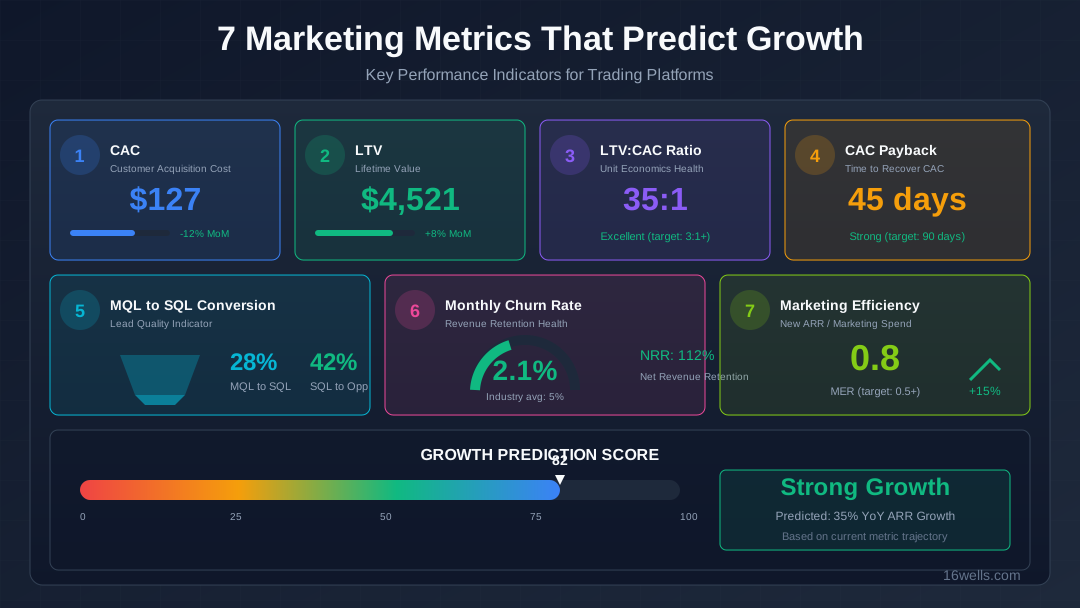
Example of a marketing dashboard
The Dashboard Problem
Every marketing team I’ve worked with has too many metrics and not enough insight. They can tell you impressions, clicks, CTRs, CPCs, and conversion rates for a dozen campaigns. They can produce beautiful charts showing month-over-month trends. But when the CEO asks “is our marketing working?”—there’s often an uncomfortable pause.
The problem isn’t a lack of data. It’s that most marketing metrics are descriptive rather than predictive. They tell you what happened, not whether it will lead to growth. For financial services and B2B companies specifically, this matters because your economics are unique: high-value customers, long consideration cycles, complex sales processes, and often recurring revenue models.
After 15 years working with financial services companies, I’ve narrowed it down to seven metrics that actually predict growth. These aren’t the only metrics that matter—but they’re the ones that tell you whether your marketing is building a sustainable, growing business.
Metric #1: Customer Acquisition Cost (CAC)
What It Tells You
CAC measures the total cost to acquire a new paying customer. It’s the foundation metric that most other efficiency calculations depend on. Without accurate CAC, you can’t evaluate any marketing investment.
How to Calculate It Correctly
The formula appears simple: Total Sales and Marketing Spend / Number of New Customers Acquired.
But the details matter. Your numerator should include:
- Paid advertising spend (all channels)
- Marketing team salaries and benefits
- Sales team salaries and benefits (for customer acquisition roles)
- Marketing technology and tools
- Agency and contractor fees
- Content production costs
- Event and sponsorship costs
Your denominator should count only customers who made their first purchase in the period—not returning customers or upgrades.
What Good Looks Like for Financial Services and B2B
CAC varies dramatically based on your business model:
- SaaS subscriptions (SMB): $150-500 per customer
- Financial services (consumer): $75-250 per customer
- B2B software platforms: $200-800 per customer
- Wealth management/advisory: $500-2,000+ per client
These are benchmarks, not targets. Your CAC should be evaluated relative to your LTV—a $2,000 CAC is fantastic if your LTV is $15,000.
Common Mistakes
Mistake #1: Calculating “blended CAC” that includes word-of-mouth and organic customers. This masks the true cost of paid acquisition. Calculate both blended CAC and paid CAC separately.
Mistake #2: Using ad spend only. Real CAC includes all the humans and systems required to convert leads to customers.
Mistake #3: Mixing time periods. If marketing spend today generates customers in 60 days, you need to lag your calculation appropriately.
Metric #2: Customer Lifetime Value (LTV)
What It Tells You
LTV predicts the total revenue (or profit) a customer will generate over their entire relationship with you. It’s the ceiling on what you can afford to pay for acquisition while remaining profitable.
How to Calculate It Correctly
For subscription businesses: LTV = Average Revenue Per User (ARPU) x Gross Margin x Customer Lifetime
Customer Lifetime = 1 / Monthly Churn Rate (for monthly billing) or 1 / Annual Churn Rate (for annual billing)
For one-time purchase businesses: LTV = Average Order Value x Gross Margin x Average Number of Purchases Per Customer
Many data-driven businesses have hybrid models—initial purchase plus ongoing subscription, or freemium conversion to paid. Calculate LTV for each segment and track cohorts over time.
What Good Looks Like for Financial Services and B2B
LTV depends entirely on your pricing and retention:
- SMB SaaS ($47-197/mo): $500-2,500 LTV (depending on retention)
- Mid-market SaaS: $5,000-25,000 LTV
- Financial services (consumer products): $200-600 LTV (accounting for cross-sells)
- Wealth management/advisory: $10,000-50,000+ LTV
Common Mistakes
Mistake #1: Using revenue instead of gross margin. LTV should reflect profit contribution, not just revenue.
Mistake #2: Overestimating customer lifetime. New businesses often project lifetime based on best customers rather than average customers.
Mistake #3: Not segmenting by acquisition channel. Customers from different sources often have dramatically different LTVs. Calculate LTV by channel to optimize your mix.
Metric #3: LTV:CAC Ratio
What It Tells You
This ratio is the single most important indicator of marketing efficiency. It tells you how much value you create for every dollar spent on acquisition.
How to Calculate It
LTV:CAC Ratio = Customer Lifetime Value / Customer Acquisition Cost
Use consistent definitions—if you’re using gross-margin-adjusted LTV, your CAC should include all costs.
What Good Looks Like
The standard benchmark is 3:1—you should generate $3 in lifetime value for every $1 spent on acquisition. Here’s how to interpret different ratios:
- Below 1:1: You’re losing money on every customer. Stop scaling immediately.
- 1:1 to 2:1: Marginally profitable or break-even. Sustainable only if you have strong referral or expansion revenue.
- 2:1 to 3:1: Healthy but watch efficiency. You have room to grow but should optimize continuously.
- 3:1 to 5:1: Strong efficiency. This is the target range for most growth-stage companies.
- Above 5:1: You may be under-investing in growth. You could likely acquire more customers profitably.
What Financial Services and B2B Should Target
For most financial services and B2B subscription businesses, target a 3:1 to 4:1 ratio. These industries have higher customer acquisition costs than average, but also tend to have higher LTVs and strong retention—which balances out.
If you’re below 3:1, focus on either reducing CAC (better targeting, improved conversion rates) or increasing LTV (better retention, more upsells) before scaling spend.
Metric #4: CAC Payback Period
What It Tells You
CAC Payback tells you how long it takes to recover your customer acquisition investment. It’s a measure of capital efficiency—how much cash you need to fund growth.
How to Calculate It
CAC Payback (months) = CAC / (Monthly Revenue Per Customer x Gross Margin)
For annual billing: CAC Payback = CAC / (Annual Revenue Per Customer x Gross Margin) x 12
What Good Looks Like
Conventional SaaS wisdom says payback should be under 12 months. For financial services:
- Under 6 months: Excellent. You can grow aggressively with minimal capital.
- 6-12 months: Good. Standard for healthy growth companies.
- 12-18 months: Acceptable if you have strong retention and high LTV.
- Over 18 months: Concerning. Requires significant capital to fund growth and increases risk.
Why This Matters for Financial Services and B2B
Many data-driven businesses have high-ticket initial conversions followed by lower-ticket recurring revenue. This creates fast initial payback but different long-term economics. Calculate payback on the initial conversion separately from total payback—it tells you how quickly you can reinvest in growth.
For example: if your initial client engagement has a $400 CAC and generates immediate revenue, you achieve payback quickly. But if you’re also counting on ongoing subscription or service revenue to reach your full LTV, your “ongoing” payback is the additional time needed to recover the CAC from recurring revenue alone.
Metric #5: MQL-to-SQL Conversion Rate
What It Tells You
This metric reveals the quality of leads your marketing generates and the effectiveness of your qualification process. It’s the bridge between marketing activity and sales outcomes.
Definitions First
Marketing Qualified Lead (MQL): A lead that meets your demographic and behavioral criteria for potential fit. They’ve shown enough interest or have the right characteristics to be worth sales attention.
Sales Qualified Lead (SQL): A lead that sales has confirmed as a genuine opportunity. They have the need, budget, authority, and timeline to potentially become a customer.
How to Calculate It
MQL-to-SQL Conversion Rate = Number of SQLs / Number of MQLs x 100
Track this weekly or monthly, depending on your volume.
What Good Looks Like
- 10-15%: Below average. Your MQL criteria may be too loose, or your content is attracting the wrong audience.
- 15-25%: Average. Room for improvement but fundamentally workable.
- 25-35%: Good. Your marketing is generating qualified interest efficiently.
- Above 35%: Either excellent targeting or overly restrictive MQL criteria (you might be leaving leads on the table).
What Financial Services and B2B Should Know
Financial services and B2B often have lower conversion rates than consumer SaaS because of longer consideration cycles and higher-stakes decisions. A 15-20% MQL-to-SQL rate is solid for high-ticket services or enterprise solutions.
If you’re below 15%, examine:
- Are you targeting the right demographics? (Company size, budget authority, decision-making role)
- Does your content set accurate expectations about your offer?
- Is your sales team properly trained to qualify complex B2B buyers?
Metric #6: Net Revenue Retention (NRR)
What It Tells You
NRR measures how much revenue you retain and grow from existing customers. It’s the most important predictor of long-term growth because it determines whether you need to constantly backfill churned revenue or whether you’re building on a growing base.
How to Calculate It
NRR = (Starting MRR + Expansion MRR – Churned MRR – Contraction MRR) / Starting MRR x 100
For non-subscription businesses, calculate based on revenue from customers acquired in a specific cohort, comparing period-over-period.
What Good Looks Like
- Below 80%: Severe churn problem. You’re losing customers faster than you can acquire them.
- 80-90%: Concerning. You need significant new customer acquisition just to maintain revenue.
- 90-100%: Healthy. Normal churn with decent retention.
- 100-110%: Good. Expansion revenue roughly offsets churn.
- Above 110%: Excellent. Your existing customer base grows even without new customers.
Why This Is Critical for Data-Driven Businesses
Many subscription businesses struggle with retention because customers either achieve their goal (they got what they needed) or fail (they didn’t get results and leave). The businesses that achieve high NRR do so by creating ongoing value through:
- Continuous value delivery (new features, updated content, market analysis)
- Community and accountability structures
- Tools that become embedded in customer workflow
- Progressive offerings that grow with the customer
Track NRR by cohort. If recent cohorts have lower NRR than older cohorts, your product-market fit may be weakening—you’re attracting less-ideal customers as you scale.
Metric #7: Marketing Efficiency Ratio (MER)
What It Tells You
MER is the blended efficiency of all your marketing investments. Unlike channel-specific ROAS, MER tells you whether your overall marketing program is working.
How to Calculate It
MER = Total Revenue / Total Marketing Spend
That’s it. No attribution complexity, no channel allocation debates. Just total revenue divided by total marketing spend.
What Good Looks Like
MER benchmarks vary by business model:
- Below 2:1: Concerning unless you’re investing heavily in brand building.
- 2:1 to 3:1: Acceptable for early-stage or high-growth companies.
- 3:1 to 5:1: Healthy for most financial services and B2B businesses.
- Above 5:1: Efficient, but may indicate under-investment in growth.
Why MER Matters More Than Ever
As tracking and attribution become less reliable (iOS privacy changes, cookie deprecation, cross-device journeys), channel-level ROAS becomes increasingly inaccurate. MER sidesteps this problem by measuring total output versus total input.
For B2B and financial services businesses with long consideration cycles, MER is especially valuable. Your Facebook ads might drive awareness that converts through organic search six weeks later. Channel attribution will miss this, but MER captures the true marketing contribution.
How to Use MER
Track MER weekly or monthly. Use it to answer: “If I increase total marketing spend by X, what should happen to revenue?” If MER stays consistent as you scale, your marketing is efficient. If MER declines as you scale, you’re hitting diminishing returns.
Combine MER with incrementality testing to understand which channels truly contribute and which are claiming credit for conversions that would have happened anyway.
Building Your Metrics Dashboard
Don’t just track these metrics—build a system that makes them actionable.
Weekly Review
- MER (total revenue / total spend)
- MQL-to-SQL conversion rate
- Paid CAC trend
Monthly Review
- Full CAC (blended and by channel)
- LTV by cohort and segment
- LTV:CAC ratio
- CAC Payback Period
- NRR
Quarterly Review
- LTV trends over time (are new cohorts as valuable as older cohorts?)
- CAC trends by channel (which channels are getting more expensive?)
- NRR by segment (which customer types have best retention?)
FAQ: Marketing Metrics for Financial Services and B2B
How do I calculate LTV when I don’t have enough customer history?
Use early indicators as proxies. For subscription businesses, 90-day retention strongly predicts long-term retention. Calculate a “minimum viable LTV” based on your current data, then update quarterly as you gather more information. Be conservative in your estimates—overestimating LTV leads to overspending on acquisition.
Should I track CAC by product or as a blended number?
Both. Blended CAC tells you overall efficiency. Product-level CAC reveals which products are economically viable for paid acquisition and which need organic/referral channels. If one product has a 4:1 LTV:CAC and another has a 1.5:1, you should allocate budget accordingly.
What if my customers buy multiple products? How do I attribute CAC?
Attribute CAC to the first product purchased, then track upgrade/cross-sell revenue as expansion. This gives you clear CAC per entry point and lets you evaluate which entry products most efficiently lead to higher LTV.
How do I handle seasonality in these metrics?
Many B2B and financial services businesses see seasonal patterns—activity spikes during budget cycles or market events, quieter periods during holidays. Compare metrics year-over-year rather than month-over-month to account for seasonality. Track trailing 12-month averages for strategic planning.
What’s more important—LTV:CAC or CAC Payback?
Both matter for different reasons. LTV:CAC tells you if the unit economics work. CAC Payback tells you if you have the capital to fund growth. A 4:1 LTV:CAC with 24-month payback requires significant cash reserves. A 2.5:1 LTV:CAC with 4-month payback is easier to fund but has thinner margins. Your situation determines which to prioritize.
How accurate do these metrics need to be?
Directionally accurate is more important than precisely accurate. If your LTV is approximately $2,500 (could be $2,200-$2,800), that’s good enough for strategic decisions. Focus on consistency in measurement so you can track trends, rather than perfection in absolute numbers.
Key Takeaways
- Focus on seven metrics that predict growth: CAC, LTV, LTV:CAC Ratio, CAC Payback, MQL-to-SQL Conversion, NRR, and MER.
- LTV:CAC ratio is the most important efficiency metric. Target 3:1 to 4:1 for sustainable growth. Below 3:1, focus on optimization before scaling.
- CAC Payback determines capital requirements. Under 12 months is good; under 6 months lets you grow aggressively.
- NRR predicts long-term trajectory. Above 100% means your existing customer base grows without new acquisition. Below 90% requires constant backfilling.
- MER is increasingly valuable as attribution breaks down. Track total revenue versus total marketing spend for true efficiency measurement.
- Track by cohort and segment. Blended metrics mask important differences between customer types, channels, and time periods.
- Weekly, monthly, and quarterly rhythms matter. Different metrics require different review cadences for actionable insights.
Skip Shean is the founder of 16wells, helping financial services companies and data-driven B2B businesses build marketing systems that scale. He’s advised companies from early-stage startups to established platforms on the metrics that drive sustainable growth.