
Reading Time: 16 minutes
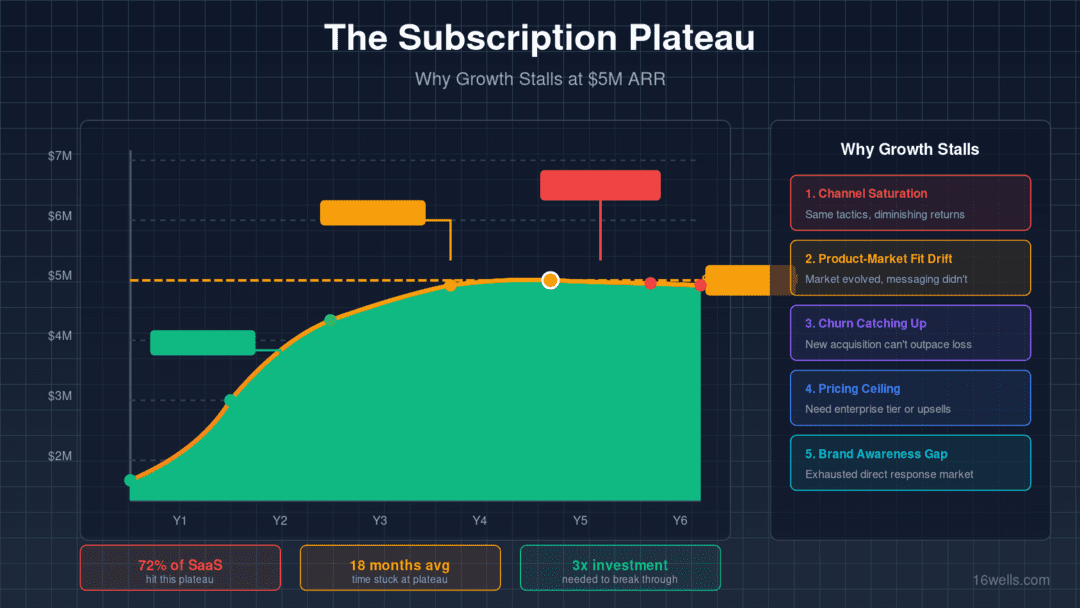
Why Growth Stalls
The $5M Wall Nobody Warns You About
There’s a pattern we see repeatedly with recurring revenue businesses across financial services, SaaS, and B2B services. The early years are exhilarating—product-market fit clicks, word of mouth kicks in, maybe some paid acquisition starts working. Revenue compounds. You hire. You invest. The trajectory looks unlimited.
Then, somewhere between $3M and $7M in annual recurring revenue, the growth curve bends. Not crashes—just bends. Month-over-month growth that was 15% becomes 8%, then 5%, then hovers stubbornly at 3%. Acquisition costs creep up. Churn becomes more visible. The team works harder but the numbers barely move.
Welcome to the plateau. Almost every subscription business hits one, and breaking through requires understanding why it happens and what to do about it.
Why Plateaus Happen: The Uncomfortable Truths
Addressable Market Saturation
The most common cause of plateau is also the most denied: you’ve captured most of the easy customers in your addressable market. The prospects who were actively looking for exactly what you sell, who were easy to reach, who converted quickly—you’ve already acquired them. What’s left is a larger but harder-to-convert population: people who need more convincing, have different needs, or weren’t actively looking.
This doesn’t mean growth is impossible—it means growth now requires either expanding your addressable market (new products, new segments, new geographies) or investing much more heavily in converting harder prospects.
Channel Exhaustion
Whatever channels drove your initial growth are now maxed out. If you grew through SEO, you’ve captured the high-intent keywords and additional ranking gains require fighting for more competitive terms. If you grew through a specific ad platform, you’ve saturated your best audiences and the algorithm is showing diminishing returns. If you grew through content or community, you’ve picked the low-hanging fruit.
Breaking through requires either dramatically increasing investment in existing channels (often with lower efficiency) or developing entirely new channels—which takes time and experimentation.
The Founder’s Ceiling
In the early days, founder energy and instinct drive growth. You can feel what’s working, make quick decisions, and personally oversee every important initiative. At $5M, that doesn’t scale. There are too many customers, too many channels, too many moving pieces. Growth now requires systems, processes, and potentially people with different skills than what got you here.
Many founders resist this transition. They want to keep doing what worked. But what worked at $1M often becomes a bottleneck at $5M.
Churn Catching Up
In the early days of a subscription business, churn is often masked by rapid growth. If you’re adding 100 customers per month and losing 5, net growth feels great. But as your customer base grows and acquisition slows, churn’s impact becomes more visible. At $5M ARR with 8% monthly churn, you’re losing $400K per month that needs to be replaced just to stay flat.
Churn that was tolerable during rapid growth becomes the primary constraint on growth during plateau.
Pricing That Doesn’t Scale
Early-stage pricing often leaves money on the table to reduce friction and accelerate growth. But pricing that made sense at $1M ARR—aggressive discounts, low-tier products, fear of charging more—becomes an anchor at $5M. Your revenue per customer is lower than it could be, making each acquisition less valuable and your economics more fragile.
The Plateau Diagnostic Framework
Before you can break through a plateau, you need to understand exactly what’s causing it. Here’s the diagnostic framework we use:
Step 1: Decompose Your Growth Equation
Monthly Recurring Revenue (MRR) changes based on a simple equation: New MRR (from new customers) + Expansion MRR (from existing customers upgrading) – Churned MRR (from customers leaving or downgrading) = Net MRR Change.
Break down your last 12 months by this equation. Where is the problem? Has new customer acquisition slowed? Has churn increased? Is expansion MRR nonexistent? The answer determines your focus.
Step 2: Analyze Acquisition Efficiency Over Time
Plot your customer acquisition cost (CAC) and volume by channel over the last 24 months. Are costs rising? Is volume flat? Which channels are degrading fastest? This reveals whether you have an acquisition efficiency problem or an acquisition volume problem.
Step 3: Cohort Your Churn
Not all churn is the same. Analyze churn by customer cohort (when they signed up), by acquisition channel, by product tier, and by customer characteristics. Often, you’ll find that churn is concentrated—recent cohorts are churning faster, a specific channel produces high-churn customers, or a particular segment is leaving. This tells you where to focus retention efforts.
Step 4: Map Your Funnel Leaks
Where in your funnel are you losing the most potential? Walk through every stage from first touch to paid customer and measure drop-off rates. Is it awareness (not enough people entering)? Interest (people leaving before they engage)? Consideration (people engaging but not converting to trial)? Conversion (people trying but not buying)? The biggest leak deserves the most attention.
Step 5: Assess Pricing Headroom
What would happen if you raised prices 20%? What about 50%? Have you actually tested this, or are you guessing? Many plateau-stage companies are dramatically under-pricing their product. The right price test can be the fastest path through a plateau.
Breakthrough Strategies: What Actually Works
Strategy 1: Attack Churn First
If your diagnostic reveals churn as a significant factor, this is almost always the highest-ROI focus area. Reducing churn has compounding effects that dwarf acquisition improvements.
Identify the critical moment: When do most churned customers decide to leave? It’s usually earlier than you think—often within the first 30 days. What’s happening (or not happening) during that window?
Implement early warning systems: What behaviors predict churn? Not logging in? Not using key features? Declining engagement over time? Build systems that identify at-risk customers before they leave, not after.
Create rescue interventions: When early warning triggers fire, what happens? Automated re-engagement campaigns? Personal outreach? Special offers? The specifics matter less than having a systematic response.
Fix the product, not just the symptoms: If customers are churning because the product doesn’t deliver enough value, no amount of rescue intervention will solve it. Sometimes the plateau is a signal that the product itself needs evolution.
Strategy 2: Expand Revenue Per Customer
If you can’t efficiently acquire more customers, extract more value from the customers you have.
Introduce premium tiers: What would a 2x or 3x priced offering include? Advanced features, more personalized service, faster support, additional access? There’s almost always a segment of your customer base willing to pay significantly more.
Add complementary products: What else does your customer need that you could provide? For a fintech platform, this might be additional financial products, premium support, or advanced analytics. For a SaaS tool, it might be integrations, training, or managed services.
Raise prices on new customers: This is the lowest-risk way to improve economics. Existing customers keep their current pricing; new customers pay more. This immediately improves acquisition efficiency and tests pricing elasticity.
Strategy 3: Expand Your Addressable Market
If you’ve saturated your current market, grow the market.
Move upmarket: Can you serve larger, more sophisticated customers who would pay significantly more? This often requires product and service enhancements but can dramatically increase deal sizes.
Move adjacent: Are there related customer segments you don’t currently serve? A wealth management platform might expand to insurance or lending. A U.S.-focused service might expand internationally.
Create entry points: Sometimes your product is too advanced or expensive for a large potential audience. Can you create a lower-friction entry product that grows the top of your funnel?
Strategy 4: Open New Acquisition Channels
If existing channels are exhausted, invest in new ones—but do it systematically.
Partnerships and affiliates: Who already has relationships with your target customers? Content creators, complementary service providers, industry associations, influencers? Partnerships can open entirely new customer pools.
Content and thought leadership: Long-form content, podcasts, video series, and industry commentary build audience over time. This is a slow-burn strategy but creates durable acquisition channels that don’t depend on paid media.
Events and community: Virtual and in-person events, user groups, and community platforms create acquisition through connection. For high-value subscription products, the relationship-building can justify the investment.
Strategy 5: Bring in Outside Expertise
Sometimes the breakthrough requires perspective and skills you don’t have internally.
Fractional leadership: A fractional CMO or growth executive brings experience from breaking through plateaus elsewhere. They can often identify blind spots and accelerate implementation of breakthrough strategies.
Strategic consulting: A focused engagement to diagnose the plateau and develop a breakthrough plan can provide the clarity needed to move forward.
Agency partnerships: Specialized agencies for specific functions (paid acquisition, content, conversion optimization) can add capability faster than hiring.
Frequently Asked Questions
How long do growth plateaus typically last?
Without intervention, plateaus can last years—some businesses never break through. With focused effort, 6-12 months is typical for meaningful progress, though this depends on the severity of the underlying issues. The key is accurate diagnosis; working on the wrong problem can extend the plateau indefinitely.
Should I focus on acquisition or retention first?
In almost all cases, retention first—especially if your churn rate is above 5% monthly. The math is compelling: reducing churn from 8% to 5% monthly on a $5M ARR base saves $150K monthly in required replacement revenue. That same $150K in acquisition at $500 CAC only adds 300 customers. Plus, retained customers can expand and refer, while churned customers are often lost forever.
How do I know if the problem is my product versus my marketing?
Look at activation and retention patterns. If people try your product and don’t stick, it’s likely a product or onboarding issue. If people stick once activated but you can’t get enough people to try, it’s likely an acquisition or positioning issue. If people stay but never upgrade or expand, it’s likely a product-market fit issue for premium offerings. Survey churned customers—their answers usually make the problem clear.
Is it normal for CAC to rise over time?
Yes, rising CAC is normal as you exhaust the easiest-to-acquire customers. The question is whether CAC is rising faster than customer value. If your LTV is also increasing (through better retention, higher pricing, or expansion revenue), rising CAC can be sustainable. If CAC is rising while LTV stays flat, you’re headed for trouble.
When should I consider raising prices?
Almost always sooner than you think. Most subscription businesses, especially in B2B and prosumer markets, are underpriced. If you haven’t raised prices in over a year, if customers rarely object to pricing, if you have strong retention despite the current price—these are all signals that pricing headroom exists. Test it.
What metrics should I obsess over during a plateau?
Net Revenue Retention (NRR) is the master metric—it captures churn, expansion, and contraction in one number. Above 100% NRR means you’re growing even without new customers. Also track CAC payback period (how quickly you recover acquisition costs), logo churn versus revenue churn (losing small customers is different from losing large ones), and LTV:CAC ratio (should be 3:1 or better for sustainable growth).
Key Takeaways
Plateaus are painful but not permanent. Every successful subscription business has hit growth walls and broken through them. The difference between businesses that escape plateaus and those that don’t usually isn’t resources or luck—it’s accurate diagnosis and focused execution.
Start with the diagnostic framework. Understand exactly what’s causing your plateau before committing to solutions. Then prioritize ruthlessly: attack churn if that’s the bottleneck, expand customer value if acquisition efficiency is dropping, broaden your market if you’ve saturated the current one.
And remember that the skills and strategies that got you to $5M are often different from what gets you to $20M. Embrace the transition rather than resisting it. The next phase of growth is waiting on the other side.