
Reading Time: 12 minutes
The Moment Every Financial Services Marketer Dreads
You’ve built a marketing engine that works. Your cost per acquisition is predictable. Your funnel converts at rates that make your competitors jealous. Then one quarter, you increase spend by 30%—and results go up by 8%. You push harder. Results barely move. Sometimes they actually decline.
This isn’t a hypothetical scenario. It’s the most common pattern I see when financial services companies call us at 16wells. They’ve hit what economists call the point of diminishing marginal returns, but unlike a textbook example, it doesn’t come with a warning label.
The instinct is usually wrong: cut the budget, fire the agency, or worse—keep spending while hoping things turn around. The right approach is diagnostic. Before you change anything, you need to understand why your marketing efficiency collapsed.
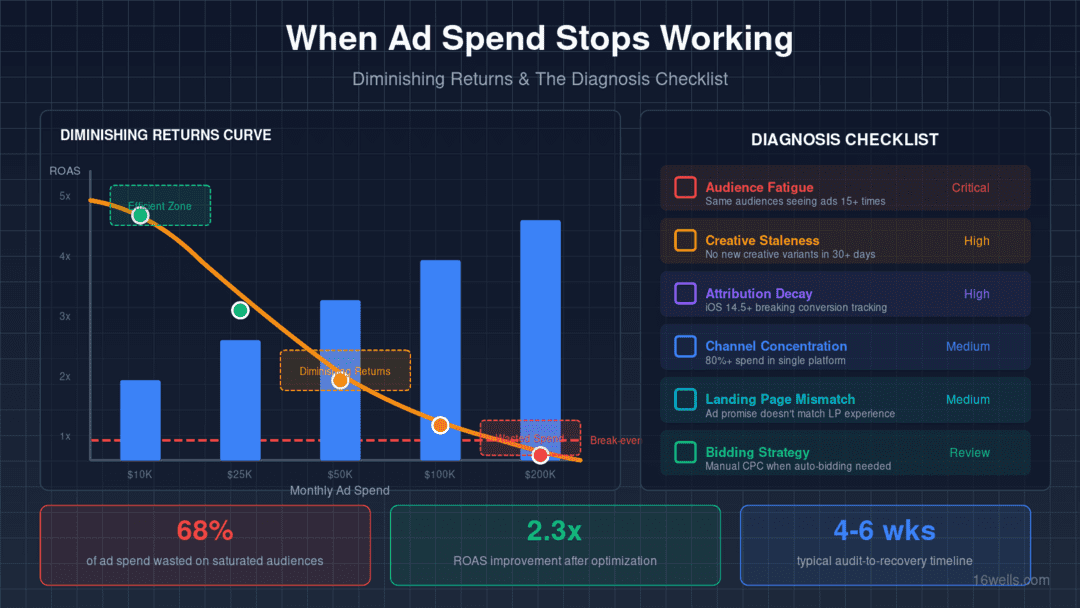
Understanding the Efficiency Curve in Financial Services Marketing
Every marketing channel follows a predictable efficiency pattern. Early spend captures high-intent audiences—people actively searching for your specific services, whether that’s wealth management, insurance quotes, lending solutions, or software trials. These prospects convert easily because they’re already in-market.
As you scale, you necessarily reach audiences with lower intent. They might be interested eventually, but they’re not ready now. Acquiring them costs more. Converting them takes longer. Your metrics shift.
For financial services specifically, this curve is steeper than most industries for three reasons:
1. Regulatory Constraints Limit Creative Options
When compliance requires specific disclaimers, restricts certain claims, and mandates particular language, you can’t simply test unlimited creative variations like a DTC brand selling supplements. This means creative fatigue sets in faster, and your options for refreshing campaigns are genuinely limited.
2. The Qualified Audience Is Finite
Not everyone qualifies for your services. Not everyone meets the requirements for certain financial products or has the budget for enterprise software. Unlike mass-market products, financial services and B2B companies often target audiences with specific characteristics—income levels, company size, sophistication requirements. You can exhaust your addressable market faster than you expect.
3. Trust Takes Time
Financial services purchases involve significant risk perception. Someone might see your ad fifty times before they’re ready to convert. Traditional attribution models miss this reality entirely, making it appear that recent spend isn’t working when it’s actually building the pipeline for future conversions.
The Five Root Causes of Ad Spend Efficiency Collapse
When we conduct diagnostic assessments for financial services clients, we work through these five areas systematically. The order matters—each subsequent cause is harder to fix than the one before it.
Root Cause #1: Creative Exhaustion
This is the most common culprit and fortunately the easiest to fix. Creative exhaustion happens when your target audience has seen your ads so many times that they’ve developed “banner blindness”—their brains literally filter out your message.
Diagnostic signals:
- Click-through rates declining week over week, even as impressions stay stable
- Frequency metrics climbing above 7-10 per month for the same audience
- Cost per click increasing while conversion rates from click to lead remain stable
- Ad platform “learning limited” or “creative fatigue” warnings
The fix: Develop a creative refresh calendar that introduces new concepts—not just new colors or minor copy tweaks—every 4-6 weeks. For regulated industries, this means having compliant creative pre-approved and ready to deploy before fatigue sets in.
One financial services company we work with maintains a library of 40+ pre-approved ad concepts at all times. When performance data shows fatigue beginning (usually a 15% CTR decline over two weeks), they swap in fresh creative within 48 hours. Their cost per lead has stayed within 12% of their target for 18 consecutive months.
Root Cause #2: Audience Saturation
You’ve reached everyone in your target audience who’s going to convert at your current offer and price point. Additional spend just shows ads to the same people more often, or reaches people outside your actual target market.
Diagnostic signals:
- Impression share is already at 90%+ for key search terms
- Audience size estimates in paid social are under 500,000 for your targeting criteria
- Lookalike audiences perform progressively worse as you expand from 1% to 3% to 5%
- Geographic expansion yields significantly worse unit economics
The fix: This is a strategic challenge, not a tactical one. You have three options: expand your addressable market (different products, lower barriers to entry), accept a higher CAC for incremental customers, or shift budget to retention and expansion revenue from existing customers.
A wealth management firm we advised faced exactly this. Their ideal client profile—business owners with $2M+ liquid assets in specific metro areas—represented about 180,000 households. They’d reached market saturation at about $400K monthly spend. Rather than pushing to $600K for marginal gains, they reallocated $150K monthly to client events, referral programs, and content marketing. Net new AUM actually increased because existing clients brought in referrals at zero acquisition cost.
Root Cause #3: Channel Saturation
Different from audience saturation. Here, you’ve maxed out what a specific channel can deliver, but there may be other channels where your audience exists.
Diagnostic signals:
- Auction insights show you’re in the top 3 positions consistently
- Increasing bids doesn’t improve position or volume meaningfully
- Quality scores are 8+ but costs keep climbing
- Your share of voice exceeds 50% for core terms
The fix: Diversify channels while maintaining measurement discipline. For financial services and B2B companies, this often means testing LinkedIn (for B2B or high-net-worth targeting), programmatic display with contextual targeting (industry news sites, professional communities), podcast sponsorships, or content partnerships.
The key is rigorous incrementality testing. Don’t just move budget and hope—run geographic or time-based holdout tests to measure true incremental impact of each new channel.
Root Cause #4: Offer Fatigue
Your audience knows what you’re selling. The ones who wanted it have already converted. The ones who haven’t converted aren’t motivated by your current value proposition.
Diagnostic signals:
- Landing page conversion rates declining even with steady traffic quality
- Email open rates dropping across all segments
- Sales team reporting that leads “already know about us” but aren’t ready to buy
- Competitor offers getting mentioned more frequently in sales conversations
The fix: This requires product or offer innovation, not just marketing optimization. Consider: new lead magnets that address different pain points, entry-level products that lower commitment, bundled offerings, limited-time promotions (within compliance limits), or repositioning that emphasizes different benefits.
A B2B fintech company refreshed their primary lead magnet from a generic “Industry Guide” to a “Weekly Market Insights” email with a specific, timely hook. Same audience targeting, same ad spend—lead volume increased 67% because the offer felt new and immediately valuable.
Root Cause #5: Competitive Dynamics Shifted
Sometimes your marketing efficiency dropped because the market changed, not because anything you did stopped working. New competitors enter with bigger budgets. Established players increase spend. Regulatory changes affect how you can market.
Diagnostic signals:
- Auction insights show new competitors or increased competitor impression share
- CPCs for core terms increased 30%+ without corresponding market growth
- Competitor creative is appearing more frequently in ad libraries
- Industry publications are covering well-funded new entrants
The fix: Competitive intelligence becomes critical. Understand where competitors are investing and why. Sometimes the right move is to compete differently—own a niche they’re ignoring, invest in brand where they’re focused on performance, or build moats through content and community that can’t be bought.
The Root Cause Analysis Framework
Here’s the systematic process we use at 16wells when a financial services client’s marketing efficiency deteriorates.
Step 1: Establish the Baseline
Before diagnosing what went wrong, you need to know what “working” looked like. Pull your key metrics—CAC, conversion rates at each funnel stage, ROAS, LTV—for the period when performance was acceptable. This is your benchmark.
Step 2: Identify the Breakdown Point
Where exactly did performance degrade? Walk through your funnel:
- Did impression delivery stay stable while clicks declined? (Creative problem)
- Did clicks stay stable while conversions declined? (Landing page or offer problem)
- Did lead volume stay stable while lead quality declined? (Targeting problem)
- Did lead quality stay stable while sales conversions declined? (Sales process or competitive problem)
Step 3: Time-Series Analysis
Plot your key metrics week over week. Look for inflection points. When exactly did things change? What else happened at that time? Did you change creative? Did a competitor launch? Did your website change? Did seasonality affect your market?
Step 4: Cohort Analysis
Compare customers acquired in different periods. Are recent customers behaving differently than customers acquired during your “good” period? Lower LTV? Higher churn? Longer sales cycles? This reveals whether you’re acquiring different (likely lower-quality) customers or whether something changed in your product or service.
Step 5: Channel-Level Decomposition
Break down performance by channel. Often, one channel has degraded significantly while others remain healthy. This points to channel-specific issues (saturation, competition, platform changes) rather than fundamental problems with your marketing.
Step 6: Test Your Hypothesis
Based on your analysis, form a hypothesis about the root cause. Then test it with a controlled experiment before making wholesale changes. If you believe creative fatigue is the issue, test new creative against your existing creative in a split test. If you believe audience saturation is the issue, test a new audience segment with your proven creative.
Recovery Strategies That Actually Work
Once you’ve identified the root cause, here are proven recovery approaches for each scenario.
For Creative Exhaustion
Build a sustainable creative operations process:
- Establish a creative testing calendar with bi-weekly new concept introductions
- Create modular compliance-approved elements that can be recombined
- Invest in video creative—it has longer effective life than static images
- Test user-generated content styles (testimonials, case studies) which feel fresh longer
For Audience Saturation
Expand your addressable market strategically:
- Develop entry-level products that reach earlier-stage prospects
- Create content that builds audience over time (organic, SEO, email)
- Invest in referral programs that leverage satisfied customers
- Consider geographic expansion with localized approaches
For Channel Saturation
Diversify with discipline:
- Allocate 10-20% of budget to channel testing with clear success criteria
- Use incrementality testing to measure true channel contribution
- Build first-party data assets that reduce dependence on platform targeting
- Invest in brand marketing that creates demand across all channels
For Offer Fatigue
Innovate your value proposition:
- Interview recent non-converters to understand objections
- Analyze competitor positioning for differentiation opportunities
- Test new lead magnets, trials, or entry-level offerings
- Consider repositioning that emphasizes different benefits
For Competitive Shifts
Find your defensible position:
- Identify niches where you have genuine advantage
- Invest in brand and content that builds moats over time
- Focus on retention and expansion of existing customers
- Build community and relationships competitors can’t replicate
When to Accept Diminishing Returns
Here’s the uncomfortable truth: sometimes diminishing returns are simply the new reality. The question isn’t whether you can return to previous efficiency—it’s whether the current efficiency is still profitable.
If your LTV is $5,000 and your CAC was $500 during the good times, a CAC of $750 still represents a healthy business—even if it feels like failure. The danger is optimizing for a metric (previous CAC) instead of optimizing for business outcomes (profitable customer acquisition at scale).
Run the math. If you can profitably acquire customers at the new CAC, the strategic question is whether to accept lower efficiency for growth, or optimize for efficiency by reducing spend. There’s no universal right answer—it depends on your business model, funding, and growth objectives.
FAQ: Diminishing Ad Spend Returns
How quickly should I act when I see performance declining?
Don’t panic at normal fluctuations—marketing performance varies week to week. Start investigating when you see 2-3 consecutive weeks of meaningful decline (15%+ from baseline) that can’t be explained by seasonality or known factors. Take decisive action once you’ve diagnosed the root cause, not before.
Should I cut ad spend when efficiency drops?
Not automatically. Cutting spend often makes things worse by reducing the data you need for optimization and ceding ground to competitors. The exception is if you’re spending into clear audience saturation—in that case, reallocating to other channels or marketing activities makes sense.
How do I know if my targeting is the problem versus my creative?
Test them independently. Run your existing creative with a new audience segment, and run new creative with your existing audience. If new audiences perform better with old creative, targeting was the issue. If old audiences perform better with new creative, creative was the issue. If both tests improve performance, you likely have both problems.
What’s a reasonable creative refresh rate for financial services?
Plan for new concepts every 4-6 weeks in active paid channels. This doesn’t mean completely new campaigns—it means fresh angles, visuals, and hooks. Build a library of 20+ pre-approved concepts so you can swap quickly when fatigue indicators appear.
How do I justify marketing spend when efficiency is declining?
Shift the conversation from efficiency metrics to business outcomes. What’s the total contribution of marketing to revenue? What would happen to the business if you stopped marketing entirely? What’s the long-term value of customers being acquired? Frame discussions around profitable growth, not just cost per acquisition.
When should I bring in outside help?
Consider external expertise when you’ve been stuck for more than a quarter, when you lack the specialized skills to diagnose the issue (data analysis, creative strategy, competitive intelligence), or when internal teams are too close to the problem to see it clearly. Fresh eyes and financial services-specific experience can accelerate diagnosis significantly.
Key Takeaways
- Declining efficiency is a symptom, not the disease. Diagnose the root cause before changing your strategy.
- The five most common causes are creative exhaustion, audience saturation, channel saturation, offer fatigue, and competitive shifts—in that order of frequency and difficulty to fix.
- Financial services faces unique challenges: regulatory constraints limit creative options, qualified audiences are finite, and trust takes time to build.
- Use systematic diagnosis: establish baselines, identify breakdown points, analyze time series and cohorts, decompose by channel, and test hypotheses before acting.
- Sometimes diminishing returns are the new normal. The question is whether customer acquisition is still profitable, not whether it’s as efficient as before.
- Build sustainable systems: creative refresh calendars, channel diversification, and first-party data assets that reduce vulnerability to efficiency fluctuations.
Skip Shean is the founder of 16wells, a marketing consultancy specializing in growth strategy for financial services and data-driven businesses. He’s helped wealth managers, fintech companies, SaaS platforms, and B2B firms diagnose and recover from growth stalls for over 15 years.