
Reading Time: 13 minutes
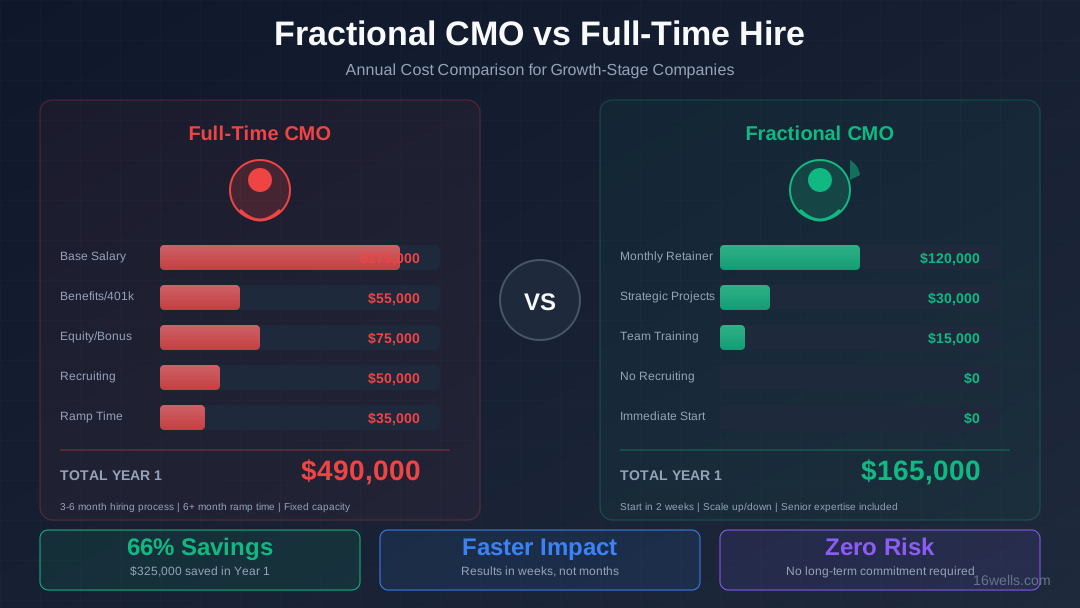
Example cost comparison of full time vs. fractional CMO. Specific projects can vary widely.
The Marketing Leadership Gap
Here’s a pattern I’ve seen dozens of times in financial services: a company reaches $3-15M in revenue with marketing that “kind of works.” Maybe the founder does most of it. Maybe there’s a marketing coordinator or manager handling execution. Maybe an agency runs paid ads. Things are growing, but nobody’s sure if they’re optimizing correctly, spending wisely, or building sustainable systems.
The obvious answer is “hire a CMO.” But when you look at the numbers, it stops making sense. A qualified Chief Marketing Officer in financial services commands $250,000-350,000 in base salary, plus equity, plus benefits, plus bonus. All-in, you’re looking at $350,000-500,000 annually for one person.
For a $10M company spending 10-15% of revenue on marketing, that single hire would consume your entire marketing budget. Even if you could afford it, would a senior executive who’s led $100M+ marketing organizations really be happy doing hands-on work at a company with a two-person marketing team?
This is the marketing leadership gap. You need strategic expertise you can’t afford and operational scale you can’t yet support. A fractional CMO bridges this gap.
What Exactly Is a Fractional CMO?
A fractional CMO is an experienced marketing executive who works with your company on a part-time, contracted basis. They provide the strategic guidance, leadership, and expertise of a full-time CMO without the full-time cost or commitment.
Typical arrangements include:
- Time commitment: 10-40 hours per month (1-2 days per week is common)
- Duration: 6-18 months, though some relationships extend for years
- Scope: Strategy, planning, team leadership, vendor management, executive partnership
- What they don’t do: Day-to-day execution, content writing, campaign management (unless explicitly included)
The best fractional CMOs have held full-time CMO or VP Marketing roles at companies larger than yours. They’ve built teams, managed significant budgets, and solved the problems you’re facing—multiple times. You’re buying their pattern recognition and strategic judgment, not their hours.
The Economics: Fractional vs. Full-Time
Let’s run the real numbers.
Full-Time CMO Costs
| Expense | Low End | High End |
|---|---|---|
| Base Salary | $250,000 | $350,000 |
| Bonus (20-30%) | $50,000 | $105,000 |
| Benefits (20-25%) | $50,000 | $87,500 |
| Equity (if applicable) | $50,000 | $150,000+ |
| Total Annual Cost | $400,000 | $692,500 |
Plus the hidden costs: 3-6 months to hire, onboarding time, risk of mis-hire (30-40% of executive hires fail within 18 months according to various studies).
Fractional CMO Costs
| Engagement Level | Monthly Investment | Annual Cost |
|---|---|---|
| Light (8-12 hrs/month) | $5,000-8,000 | $60,000-96,000 |
| Standard (15-25 hrs/month) | $8,000-12,000 | $96,000-144,000 |
| Deep (30-40 hrs/month) | $12,000-18,000 | $144,000-216,000 |
The math is straightforward: you get 50-70% of the value at 20-35% of the cost.
What You Trade Off
Fractional arrangements have real limitations:
- Availability: They’re not there every day. Urgent requests may wait 24-48 hours.
- Context: They’re working with multiple clients. They won’t know every detail of your business.
- Execution: They’re not doing the work—they’re directing and reviewing it.
- Culture: They’re advisors, not employees. They influence but don’t fully own outcomes.
For companies under $20M, these trade-offs are usually acceptable. As you grow, the calculus changes.
When Fractional CMO Is the Right Choice
Based on working with financial services companies at various stages, here are the scenarios where fractional makes the most sense:
Scenario 1: You’re Between $2-20M Revenue
This is the sweet spot. You have real marketing investment to deploy but not enough to justify a C-suite salary. You need strategic direction to avoid expensive mistakes. A fractional CMO helps you build the right foundation before you’re big enough to hire someone permanent.
Scenario 2: Your Marketing Lacks Direction
You have tactics but no strategy. You’re running ads, posting content, sending emails—but nobody’s asking whether these activities connect to business goals. A fractional CMO brings the strategic layer that connects activities to outcomes.
One B2B fintech company we work with had a marketing coordinator, an agency for paid media, and a freelancer for content. All three were competent at execution but kept asking “what should we focus on?” A fractional CMO established the strategy, set priorities, and aligned the team around shared goals. Within six months, their CAC dropped 34% because everyone was pulling in the same direction.
Scenario 3: You’re Preparing for Growth
You’re about to raise funding, launch a new product, or enter a new market. You need marketing expertise to capitalize on the opportunity but can’t spend three months hiring. A fractional CMO can engage within weeks and contribute immediately.
Scenario 4: You’ve Had Marketing Leadership Failures
Maybe your last two VP Marketing hires didn’t work out. You’re gun-shy about making another expensive commitment. A fractional arrangement lets you get leadership value with less risk. If it’s not working, you can adjust or exit the relationship much more easily than firing an employee.
Scenario 5: You Need Specific Expertise
Financial services marketing has specialized requirements—compliance, regulatory constraints, specific audience dynamics. A fractional CMO with financial services experience brings immediately relevant expertise that a generalist full-time hire might lack.
When Full-Time Is the Better Choice
Fractional isn’t always right. Consider full-time when:
You’re Over $30M Revenue
At this scale, marketing complexity usually demands full-time attention. You’re managing larger teams, bigger budgets, and more sophisticated initiatives. The cost of fractional starts approaching full-time anyway.
Marketing Is Your Core Competitive Advantage
If marketing innovation drives your business model—if you’re competing primarily on customer acquisition efficiency—you may need someone whose entire focus is your company. Fractional attention isn’t enough.
You Have Significant M&A or IPO Plans
Major transactions require someone fully embedded in the business, available for investor meetings, due diligence, and strategic planning. Part-time presence won’t suffice.
You’re Ready to Build a Large Team
If you’re hiring 5+ marketers in the next year, you need someone present to interview, onboard, and develop them. Fractional works well for small teams; larger teams need daily leadership.
What a Fractional CMO Actually Does
Let me demystify the deliverables. Here’s what a typical engagement looks like:
Month 1: Discovery and Assessment
- Deep-dive into current marketing performance
- Audit of messaging, positioning, and competitive landscape
- Review of technology stack and data infrastructure
- Assessment of team capabilities and gaps
- Initial strategic recommendations
Months 2-3: Strategy and Planning
- Develop marketing strategy aligned with business goals
- Create 12-month marketing roadmap with quarterly priorities
- Define target customer profiles and messaging framework
- Establish KPI dashboards and reporting cadence
- Recommend team structure and hiring priorities
Months 4-12: Execution Oversight and Optimization
- Weekly or bi-weekly check-ins with marketing team
- Monthly executive updates with leadership team
- Quarterly strategy reviews and plan adjustments
- Vendor/agency management and accountability
- Campaign review and optimization recommendations
- Hiring support (defining roles, interviewing, onboarding)
The Real Value: Pattern Recognition
The most valuable thing a fractional CMO provides isn’t on any deliverables list. It’s the ability to see around corners based on having done this before.
They’ll tell you “we tried that exact approach at my last company—here’s what actually worked.” They’ll flag that your agency’s recommended strategy has warning signs they’ve seen before. They’ll know that your current metrics, while seemingly fine, predict a problem in six months.
This pattern recognition saves you from expensive mistakes and accelerates your learning curve. You’re essentially buying a decade of experience condensed into monthly strategic guidance.
How to Evaluate a Fractional CMO
Not all fractional executives are equal. Here’s what to look for:
Relevant Industry Experience
For financial services, this matters more than most industries. Compliance requirements, audience sophistication, and regulatory constraints are unique. Someone who’s only marketed consumer products will have a steep learning curve.
Ask: “What financial services companies have you worked with? What specific challenges did you help them solve?”
Stage-Appropriate Experience
A CMO who’s only led marketing at Fortune 500 companies may struggle with the resource constraints of a $10M business. Look for someone who’s worked at companies similar to your current stage, ideally who grew with companies through your target stage.
Ask: “What’s the smallest company you’ve led marketing for? How did your approach differ from larger organizations?”
Strategic vs. Tactical Balance
Some fractional CMOs are strategy-only—they’ll give you a plan but won’t help implement it. Others are too tactical and don’t provide the strategic leadership you need. Look for someone who can flex between strategic guidance and practical problem-solving.
Ask: “Walk me through a recent engagement. What did you actually do week to week?”
Communication Style
They’ll be interacting with your CEO, board, and team. Their communication style needs to fit your culture. Are they direct or diplomatic? Data-driven or narrative-focused? Formal or casual?
Ask: “How do you typically communicate with CEOs and leadership teams? Can you share an example of a difficult conversation you had to have?”
References from Similar Situations
Ask for references from companies of similar size, in similar industries, facing similar challenges. Generic testimonials don’t tell you whether they’ll succeed in your specific context.
Making the Relationship Work
Once you’ve engaged a fractional CMO, here’s how to maximize the value:
Set Clear Expectations
Define what success looks like at 90 days, 6 months, and 12 months. Agree on specific metrics they’ll influence. Be explicit about what’s in scope and out of scope. More clarity upfront means fewer misunderstandings later.
Ensure CEO Access
A fractional CMO needs regular access to leadership. If they’re filtered through layers or only meet with the CEO quarterly, they can’t do their job effectively. Plan for at least bi-weekly CEO touchpoints.
Provide Context Generously
They’re not in every meeting. Over-communicate about business changes, customer feedback, competitive moves, and internal dynamics. The more context they have, the better their advice will be.
Introduce Them Properly
Don’t introduce them as “a consultant.” Position them as “our Chief Marketing Officer” or “our head of marketing strategy.” This gives them the authority to lead effectively and signals to the team and vendors that they speak for the company.
Give Them Real Authority
If they recommend firing an underperforming agency or restructuring the team, be prepared to act. A fractional CMO without authority is just an expensive advisor. They need to be able to make decisions, not just recommendations.
Real Results: What to Expect
Here are outcomes from actual fractional CMO engagements at financial services companies (details anonymized):
Case Study 1: Financial Education Company
Starting point: $8M revenue, 3-person marketing team, CAC $380, no clear marketing strategy
12-month results:
- CAC reduced to $245 (35% improvement)
- Marketing-sourced revenue increased 62%
- Team expanded to 5 people with clear roles
- Replaced underperforming agency, hired new partner
- Established attribution model and KPI dashboard
Investment: $12,000/month ($144,000 annually)
Case Study 2: B2B SaaS Platform
Starting point: $4M revenue, founder doing all marketing, no systematic lead generation
12-month results:
- Lead flow increased from 50 to 300+ per month
- Built and launched content marketing program
- Hired first marketing manager and defined role
- Established product marketing for new feature launches
- Revenue grew to $6.8M (founder attributed 50% to marketing improvements)
Investment: $8,000/month ($96,000 annually)
Case Study 3: Wealth Management Firm
Starting point: $14M AUM-based revenue, strong referral base, wanted to add digital acquisition
12-month results:
- Launched first-ever paid acquisition program
- Added $2.3M in new AUM from digital channels
- Built compliant content library (47 pieces)
- Established marketing operations and automation
- Created referral tracking system that increased referrals 28%
Investment: $10,000/month ($120,000 annually)
The Transition: Fractional to Full-Time
Many companies start with a fractional CMO and eventually hire full-time. Here’s how to plan for that transition:
Define the Trigger Points
When does fractional no longer make sense? Common triggers include:
- Marketing team grows beyond 6-8 people
- Revenue exceeds $25-30M
- Marketing budget exceeds $2-3M annually
- You need someone in the office daily
Build the Foundation First
A good fractional CMO builds systems that make their eventual replacement easier. They document strategies, establish processes, and develop team members. This makes onboarding a full-time hire much smoother.
Consider the Conversion
Sometimes the right full-time hire is someone already on your team who’s developed under the fractional CMO’s guidance. Other times, the fractional CMO has built enough foundation that you can hire a VP Marketing instead of a full CMO—at $150-200K instead of $300-350K.
Plan the Handoff
Keep the fractional CMO involved for 60-90 days after the full-time hire starts. They can transfer knowledge, introduce key relationships, and help the new person get up to speed faster.
FAQ: Fractional CMO Considerations
How many clients does a typical fractional CMO work with simultaneously?
Most work with 3-5 clients at a time, depending on engagement depth. If they’re working with more than 6-7 clients, question whether they can give you adequate attention. Ask directly about their current client load and how they manage competing demands.
What’s the minimum commitment to see results?
Expect at least 6 months to see meaningful results. Marketing changes take time to implement and even longer to produce measurable outcomes. 12-month engagements are ideal for strategic impact. Three-month engagements are really just consulting projects, not fractional leadership.
Can a fractional CMO help with hiring?
Yes, and this is one of their most valuable contributions. They can define roles, create job descriptions, source candidates through their network, lead interviews, and onboard new hires. They know what “good” looks like because they’ve hired marketing teams before.
How do I know if it’s not working?
Warning signs include: lack of clear strategic direction after 90 days, team confusion about priorities, no measurable progress on agreed KPIs, or poor communication and availability. Have an explicit check-in at 90 days to evaluate fit.
What if our needs change?
Good fractional arrangements include flexibility to scale up or down. If you need more hours for a product launch, add them temporarily. If things slow down, reduce the engagement. This flexibility is a key advantage over full-time hires.
Should our fractional CMO attend board meetings?
Usually, yes. They should present marketing strategy and results at least quarterly. This gives the board confidence that marketing is professionally led, and gives the fractional CMO visibility into company-level strategy and expectations.
Key Takeaways
- Fractional CMO fills the leadership gap for companies between $2-20M who need strategic marketing expertise but can’t justify $400K+ for a full-time executive.
- Economics favor fractional at earlier stages: $60,000-216,000 annually versus $400,000-700,000 for full-time, with less hiring risk and faster engagement.
- The real value is pattern recognition: experienced executives who’ve seen your problems before and can help you avoid expensive mistakes.
- Look for relevant experience: industry expertise (financial services), stage-appropriate background, and the right balance of strategic and tactical capability.
- Set clear expectations: define success metrics, ensure leadership access, and give them real authority to make changes.
- Plan the transition: most companies eventually hire full-time, and a good fractional CMO builds the foundation for their own replacement.
Skip Shean is the founder of 16wells, where he serves as fractional CMO for financial services companies and data-driven B2B businesses including fintech, SaaS, wealth management, and insurance firms. He’s helped companies from $2M to $50M build marketing organizations that drive sustainable growth.