
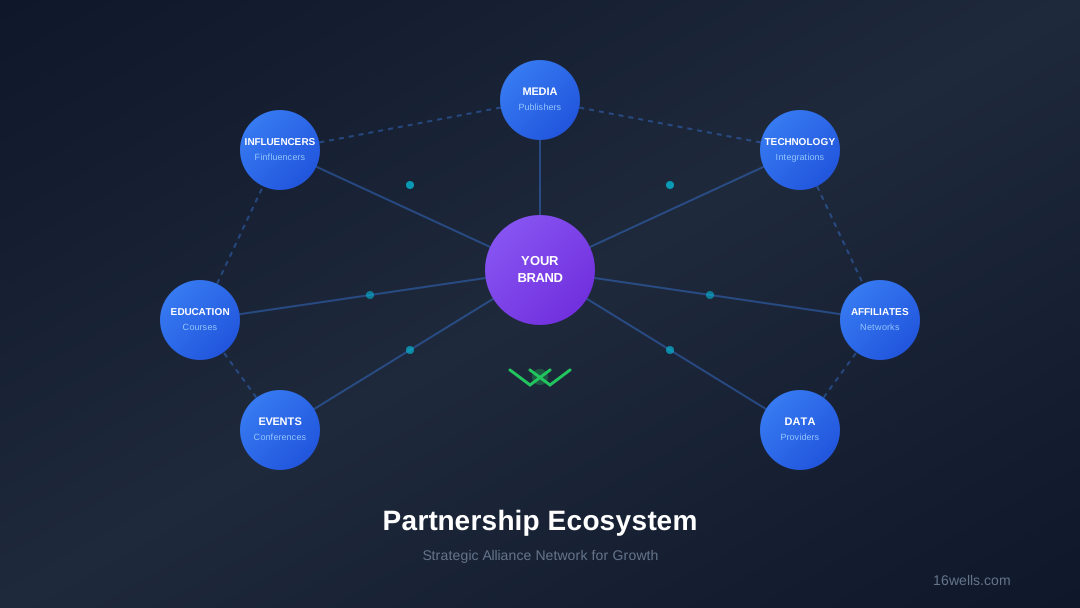
Why Partnerships Matter for Financial Services and Data-Driven Businesses
Acquiring customers through advertising alone is expensive and often unsustainable. Customer acquisition costs in competitive markets can exceed $500 per conversion, with no guarantee that acquired customers will be active or valuable. Paid channels are getting more expensive as companies compete for attention.
Partnerships offer an alternative path—and often a more effective one. The right partnership can deliver:
- Lower acquisition costs: Partners already have the audience you want to reach. Working through them is often cheaper than building that audience yourself.
- Higher quality customers: Customers who come through trusted partners often convert better and retain longer than those from cold advertising.
- Credibility transfer: Association with respected vendors, content providers, or industry figures builds trust that money can’t buy directly.
- Competitive moats: Exclusive partnerships create barriers that competitors can’t simply outspend.
- Market access: Some markets and customer segments are only reachable through partnerships.
But partnerships also require different skills than traditional marketing. They involve negotiation, relationship management, and long-term commitment. This playbook covers how to build a partnership strategy that complements your marketing efforts and drives sustainable growth.
Strategic Vendor Relationships
For financial services firms and data-driven businesses, vendor relationships are foundational. They determine what capabilities you can offer, how you operate, and increasingly, how you acquire customers.
Types of Vendor Partnerships
Technology integration: At minimum, you need technical connectivity to key platforms and services. While not a marketing partnership per se, your technology infrastructure affects what marketing claims you can make about capabilities and performance.
Data provider relationships: For data-driven businesses, relationships with data providers involve access agreements, pricing arrangements, and technology partnerships. These affect your economics and competitive positioning.
Co-marketing partnerships: Many vendors actively support customers that drive significant usage. This support can include joint marketing programs, shared educational content, promotional incentives, and co-branded materials.
Product partnerships: Launching new offerings often requires vendor partnership—new integrations, specialized access, or early mover opportunities for emerging capabilities.
Building Vendor Relationships
Vendors care about revenue and adoption. Your value to them depends on how much business you can bring. Early-stage companies may struggle to get attention from major vendors, but that doesn’t mean relationships are impossible.
Start with relationship building: Attend vendor events. Meet the business development and relationship management teams. Understand their priorities and pain points. Personal relationships matter in this space.
Demonstrate growth potential: Even if your current volume is small, show growth trajectory and explain your customer acquisition strategy. Vendors invest in companies they believe will grow.
Find niche opportunities: Major vendors have multiple product lines with varying competitive intensity. You might not be interesting for their flagship products but could be valuable for newer or less competitive offerings.
Consider emerging vendors: Regional vendors, newer services, and emerging capabilities often have less competition for partnerships. Building track record with smaller partners can help you approach larger ones.
Maximizing Vendor Partnership Value
Once you have vendor relationships, extract maximum marketing value:
Leverage co-marketing programs: Many vendors offer marketing support for partners who commit to promoting their services. This can include advertising credits, content support, event sponsorship, and promotional tools.
Access educational content: Vendors produce substantial educational content about their products. Often this content can be white-labeled or co-branded for your use.
Participate in vendor events: Vendor-sponsored events, webinars, and conferences put you in front of active customers. Speaking opportunities and sponsorships build credibility.
Feature exclusive access: If you have early or exclusive access to new capabilities, make this a marketing advantage. Being first matters to sophisticated customers.
Content Provider Partnerships
Content providers—data vendors, research platforms, educational sites, and media properties—have audiences you want to reach. Partnership can connect you to these audiences.
Types of Content Partnerships
Data and tools integration: Integrating third-party data, research, or tools into your offering creates customer value and partnership opportunities. Data providers often promote companies that feature their content.
Educational content partnerships: Education providers can recommend your services as the implementation venue for strategies they teach. These partnerships create natural customer acquisition channels.
Media sponsorships: Sponsoring relevant media content—podcasts, newsletters, video series—puts your brand in front of engaged audiences. Beyond advertising, deeper content partnerships can involve co-creation.
Research distribution: Companies that distribute research from recognized providers gain credibility and create reasons for customers to use your services specifically.
Structuring Content Partnerships
Effective content partnerships require alignment of incentives:
Revenue sharing: Many content providers will promote your company in exchange for a share of revenue from customers they refer. This aligns incentives—they’re motivated to send quality leads because they benefit from those leads’ value.
Flat fees: For established content providers with proven track records, flat fee arrangements may make sense. You pay a fixed amount for specific promotional commitments.
Hybrid models: Combining a smaller flat fee with revenue sharing can work for both parties—the partner gets guaranteed income while maintaining upside from quality referrals.
In-kind exchanges: Sometimes the best partnership involves trading value rather than cash—your company features their content, they promote your company. This works when both parties have something the other wants.
Evaluating Potential Content Partners
Not all content providers make good partners. Evaluate potential partners on:
Audience quality: Does their audience match your target customer? A massive audience of casual browsers may be less valuable than a smaller audience of serious decision-makers.
Engagement depth: How engaged is their audience? Email open rates, content consumption metrics, and community activity indicate whether promotion will actually be seen.
Brand alignment: Does association with this partner enhance or risk your brand? Some content providers have reputations that could help or hurt you.
Exclusivity possibilities: Can you secure exclusive or preferred status? Non-exclusive partnerships are less valuable when competitors can access the same audience.
Track record: Has this partner successfully driven results for other companies? Ask for case studies and references.
Affiliate Programs
Affiliate programs mobilize external parties—influencers, educators, bloggers, existing customers—to promote your company in exchange for compensation.
Affiliate Program Structure
Compensation models:
- CPA (Cost Per Acquisition): Fixed payment for each new converted customer. Simple but doesn’t align ongoing incentives.
- Revenue share: Percentage of revenue generated by referred customers. Aligns incentives for quality but creates longer-term obligations.
- Hybrid: Upfront CPA plus smaller ongoing revenue share. Balances immediate motivation with quality incentives.
- Tiered structures: Increasing compensation as affiliates reach volume thresholds. Motivates growth and rewards top performers.
Attribution and tracking: Clear attribution is essential. Most programs use tracking links and cookies, but attribution windows, multi-touch considerations, and cross-device tracking create complexity. Choose technology that provides reliable attribution without creating excessive friction for users.
Payment terms: When and how affiliates get paid affects who participates. Faster payments attract more affiliates but increase risk. Holding periods help catch fraud and chargebacks but discourage some participants.
Affiliate Recruitment and Management
Finding affiliates: Quality affiliates don’t appear automatically. Recruit through:
- Direct outreach to content creators and influencers in your space
- Affiliate networks that aggregate publishers
- Converting existing customers into referral partners
- Industry events and community participation
Enabling affiliate success: Affiliates perform better with support:
- Marketing materials they can use (banners, copy, landing pages)
- Training on your value proposition
- Regular communication about new features and promotions
- Performance data so they can optimize their efforts
Managing compliance: Affiliates represent your brand. Ensure they:
- Follow regulatory requirements for financial services advertising
- Use only approved marketing materials and claims
- Disclose their affiliate relationship appropriately
- Don’t engage in practices that could damage your reputation
Optimizing the program: Continuously improve by:
- Analyzing which affiliates drive quality customers (not just volume)
- Testing different compensation structures
- Removing affiliates who violate terms or send low-quality traffic
- Investing more in top performers
Affiliate Program Risks
Affiliate programs carry risks that must be managed:
Brand risk: Affiliates may represent your brand inappropriately. Monitor how affiliates promote you and act quickly when problems arise.
Fraud: Some affiliates will attempt to game attribution systems or send fraudulent traffic. Implement fraud detection and maintain clawback provisions.
Regulatory risk: In financial services, affiliate advertising faces regulatory scrutiny. Ensure your program and participants comply with applicable rules.
Quality dilution: Optimizing purely for volume can degrade customer quality. Track customer lifetime value by affiliate source and adjust compensation accordingly.
Strategic Technology Partnerships
Beyond content and distribution, technology partnerships can create competitive advantage.
Platform Integration Partnerships
Integrating with complementary platforms creates mutual benefit:
Complementary tools: Analysis platforms, workflow tools, and management software often support multiple providers. Being the preferred or default provider for popular tools creates customer acquisition opportunities.
Ecosystem apps: Business applications, productivity software, and workflow platforms increasingly integrate with financial and data services. These integrations create visibility and can drive new customer signups.
Social and community platforms: Community platforms connect to service providers. Partnership with growing community platforms can bring volume.
API and Developer Partnerships
A robust API ecosystem creates partnership opportunities:
Developer tools: Providing easy-to-use APIs attracts developers who build tools on your platform. Their tools bring their users.
Startup partnerships: Startups often need established capabilities. Partnership lets you power their offerings while they build your volume.
Enterprise solutions: Some companies partner with enterprise clients who need white-label solutions. These B2B relationships can drive substantial volume.
Negotiating Partnerships
Successful partnerships require successful negotiations. Here’s how to approach them.
Preparation
Before entering negotiations:
- Understand your own value clearly—what do you bring to the partnership?
- Research the potential partner thoroughly—their business model, priorities, and alternatives
- Define your objectives and constraints—what must you achieve, and what can’t you accept?
- Identify your BATNA (best alternative to negotiated agreement)—what will you do if this deal doesn’t happen?
Value Creation Focus
The best negotiations expand the pie before dividing it:
- Look for creative structures that serve both parties’ interests
- Understand what the partner values that costs you little to provide
- Consider non-monetary value exchanges
- Think long-term—a deal that works for both parties persists
Key Terms to Consider
Exclusivity: Exclusive partnerships are more valuable but require more commitment. Consider limited exclusivity—specific markets, time periods, or customer segments.
Performance requirements: Set clear expectations for what each party will deliver. Include minimum thresholds and consequences for missing them.
Term and renewal: How long is the commitment? What are renewal terms? Exit provisions? Neither party should feel trapped.
Economic terms: Beyond the headline number, understand payment timing, audit rights, and what happens in edge cases.
Marketing commitments: Specify promotional obligations clearly. Vague commitments lead to disappointment.
Avoiding Common Mistakes
Over-committing: In eagerness to close a deal, companies sometimes commit to terms they can’t sustain. Be realistic about what you can deliver.
Under-protecting the brand: Ensure you have appropriate approval rights over how partners represent you.
Ignoring economics at scale: A deal that looks good for small volumes may not work at scale. Model different scenarios.
Neglecting the relationship: The agreement is the start, not the end. Plan for ongoing relationship management.
Managing Partnership Portfolios
Mature companies manage portfolios of partnerships that work together strategically.
Portfolio Balance
Consider balance across several dimensions:
Partnership types: Don’t over-rely on any single type. Mix vendor relationships, content partnerships, affiliates, and technology integrations.
Size and stage: Include both established partners with proven track records and emerging partners with growth potential.
Customer segments: Different partnerships reach different audiences. Ensure coverage across your target segments.
Economic structures: Mix fixed-cost and variable-cost partnerships to manage financial exposure.
Performance Management
Track partnership performance systematically:
Attribution: Accurately attribute customer acquisition to partnership sources.
Quality metrics: Track not just acquisition but customer quality—conversion rates, activity levels, lifetime value.
ROI calculation: Calculate return on partnership investment including all costs (fees, internal resources, opportunity costs).
Comparative analysis: Compare partnership performance to other acquisition channels and to each other.
Relationship Investment
Partnerships require ongoing investment:
Regular communication: Don’t just reach out when there are problems. Maintain regular touchpoints.
Mutual planning: Involve key partners in your planning and understand theirs.
Problem resolution: Address issues quickly and fairly. How you handle problems shapes long-term relationships.
Recognition: Acknowledge partner contributions and celebrate shared successes.
Building a Partnership Function
As partnership importance grows, consider building dedicated capabilities.
Dedicated Partnership Team
Partnership management requires different skills than traditional marketing:
- Relationship building and maintenance
- Negotiation and deal structuring
- Cross-functional coordination (legal, compliance, technology, marketing)
- Long-term strategic thinking
Consider hiring or developing specialists rather than expecting marketing generalists to manage complex partnerships.
Partnership Infrastructure
Support partnerships with appropriate infrastructure:
Technology: Systems for tracking, attribution, payment, and reporting. Partners expect professional infrastructure.
Legal: Templates and processes for partnership agreements. Legal review shouldn’t be a bottleneck.
Compliance: Clear guidelines for what partners can and cannot do. Training and monitoring capabilities.
Integration: Technical capability to support partner integrations and data sharing.
Partnership Strategy
Develop an explicit partnership strategy that addresses:
- Which partnership types are priorities?
- What makes an ideal partner for each type?
- How do partnerships fit with overall growth strategy?
- What resources will be dedicated to partnership development?
- How will partnership success be measured?
Future Partnership Trends
The partnership landscape continues evolving. Trends to watch:
Embedded Services
Financial and data capabilities increasingly embed into non-financial platforms—banking apps, social networks, lifestyle brands. Partnerships that enable these integrations represent significant opportunity.
Ecosystem Competition
Competition increasingly happens between ecosystems rather than individual companies. Building strong partnership networks creates competitive moats.
Regulatory Evolution
Regulatory attention on influencer marketing and affiliate relationships is increasing. Partnerships must be structured to survive regulatory scrutiny.
International Expansion
Partnerships can enable international expansion without building local operations. Local partners provide market access, regulatory navigation, and cultural expertise.
Frequently Asked Questions
How do we approach potential partners when we’re a smaller company?
Smaller companies can still build meaningful partnerships by focusing on niche value. Identify what you can offer that larger competitors can’t—more attentive service, willingness to customize, faster decision-making, or focus on underserved segments. Target partners who are themselves emerging or who have been overlooked by larger companies. Start with smaller commitments to prove value before seeking larger deals. Sometimes being a smaller partner’s priority is better than being a large partner’s afterthought. Build track record and references that help you approach increasingly prominent partners over time.
What should we pay affiliates? How do we set competitive rates?
Affiliate compensation should balance competitiveness with unit economics. Research what competitors pay—affiliate forums and networks often have this information. Calculate your customer lifetime value and work backward to what you can afford to pay for acquisition while maintaining acceptable margins. Consider that higher payouts attract more and better affiliates, but overpaying creates unsustainable economics. Test different structures—some affiliates prefer guaranteed CPAs while others want higher potential through revenue share. Track quality by affiliate source and adjust compensation to reward partners who send valuable customers versus those who just send volume.
How do we handle exclusive partnership requests?
Exclusivity has value but also cost. Before granting exclusivity, understand what you’re giving up—potential partnerships with competitors, flexibility to pursue alternatives, negotiating leverage for renewal. If a partner requests exclusivity, ask what they’ll commit in return—guaranteed volumes, marketing investment, preferred placement. Consider limited exclusivity: specific geographies, customer segments, time periods, or product areas rather than blanket exclusivity. Include performance requirements that allow you to exit exclusivity if the partner underperforms. Never grant perpetual exclusivity—build in review periods. Sometimes the right answer is declining exclusivity but offering other forms of preferred status.
How do we manage compliance risk with affiliate marketing in financial services?
Compliance risk in affiliate programs requires active management. Start with clear affiliate agreements that specify compliance obligations and consequences for violations. Provide approved marketing materials and require their use—don’t let affiliates create their own claims about your company. Implement monitoring to catch violations—search for your brand, review affiliate content, use technology to track claims being made. Train affiliates on what they can and cannot say, with specific examples. Maintain documentation showing your compliance efforts. Build in clawback provisions so you can recover commissions for customers acquired through non-compliant promotion. Consider requiring affiliate pre-approval of marketing materials, especially for larger partners.
When should we invest in building a dedicated partnerships team?
The right time for dedicated partnership resources depends on partnership complexity and potential. If you’re managing more than 10-15 meaningful partnerships, handling significant affiliate volume, or pursuing strategic relationships that require sustained attention, dedicated resources make sense. The tipping point often comes when partnership management starts suffering because people have other priorities—missed opportunities, slow responses, or relationship deterioration signal the need for focus. Start with a partnership manager who can handle multiple functions before building a full team. As the portfolio grows and diversifies, add specialists for different partnership types or functions (affiliate management, vendor relationships, business development).
How do we measure partnership ROI when attribution is complicated?
Partnership attribution challenges are real but manageable. Use multiple approaches: direct tracking through dedicated links and codes, survey-based attribution asking new customers how they heard about you, incrementality testing comparing periods or markets with and without partner activity, and cohort analysis comparing customer quality from different sources. Accept that attribution will never be perfect—focus on being directionally right rather than precisely wrong. For complex partnerships involving brand value and long-term benefits, develop frameworks that estimate harder-to-measure value. Regular partnership reviews should assess both quantitative metrics and qualitative value like credibility enhancement and market access.
Key Takeaways
- Partnerships complement marketing: Strategic partnerships often deliver better CAC and customer quality than direct advertising alone. Build partnership capability alongside marketing capability.
- Vendor relationships are foundational: Beyond capabilities, vendors offer co-marketing support, educational content, and credibility that enhance your competitive position.
- Content partnerships drive quality acquisition: Partners with engaged audiences can deliver customers more cost-effectively than cold acquisition. Evaluate partners on audience quality, not just size.
- Affiliate programs scale reach: Well-structured affiliate programs mobilize external promoters, but require active management of compliance, quality, and fraud risks.
- Negotiate for mutual value: The best partnerships work for both parties. Focus on creating value before dividing it, and structure deals that both sides want to maintain.
- Manage portfolios strategically: Balance partnership types, sizes, and structures. Track performance, invest in relationships, and continuously optimize your partnership mix.
- Build dedicated capability: As partnerships grow in importance, invest in specialized teams, infrastructure, and strategy to maximize their value.