
TL;DR: Most financial services education marketing fails because it relies on get-rich-quick promises, flashy lifestyle imagery, and unrealistic outcome claims that trigger regulatory scrutiny and erode trust with serious prospects. Successful financial services companies differentiate themselves by leading with educational value, building transparent track records, focusing on skill development over income promises, and creating sustainable marketing systems that attract customers who actually complete programs and get results. This article breaks down the exact framework for marketing financial education that builds a lasting business.
Reading Time: 12 minutes
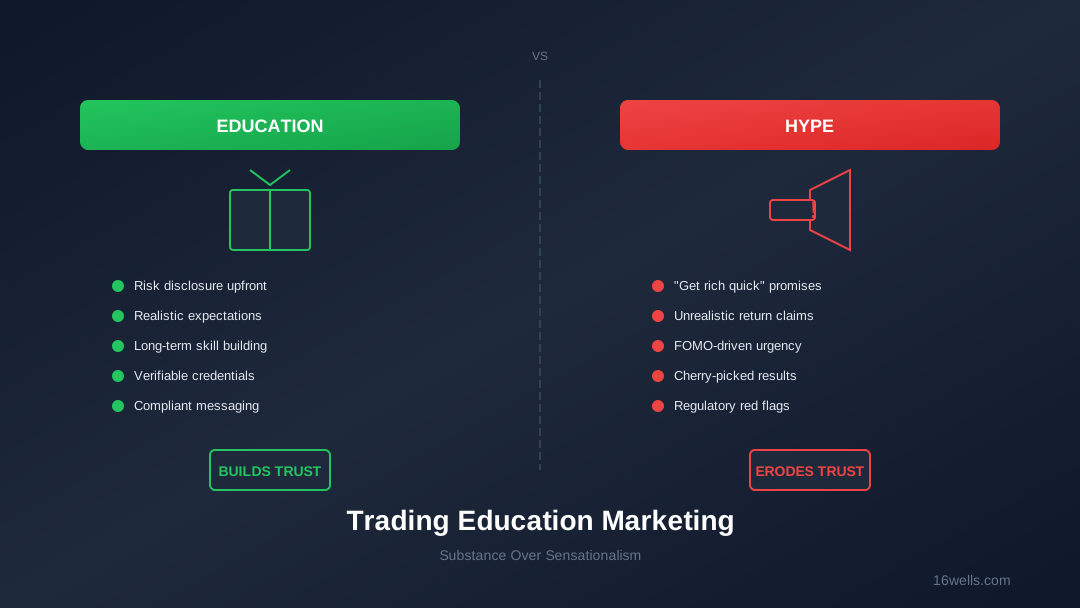
The Financial Services Education Marketing Problem Nobody Wants to Discuss
Walk through any financial services education company’s marketing funnel, and you’ll likely encounter the same tired playbook: screenshots of impressive results, testimonials about life-changing outcomes, images of expensive cars, and promises of “financial freedom” within months. This approach worked in 2015. It’s poison in 2025.
Here’s the uncomfortable truth: the financial education industry has a reputation problem, and most of it is self-inflicted through marketing that prioritizes short-term conversions over long-term sustainability. Regulators are watching. Platforms are cracking down. And most importantly, sophisticated prospects—the ones who actually complete courses and could become your best advocates—can smell hype from a mile away.
At 16wells, we’ve worked with financial education companies ranging from one-person course creators to multi-million dollar platforms, including wealth management firms, fintech startups, and B2B SaaS companies. The pattern is consistent: companies that market like infomercials eventually hit a wall. Those that market like legitimate educational institutions build sustainable businesses.
Let’s break down what separates the two.
Why Traditional Financial Services Education Marketing Fails
The Get-Rich-Quick Trap
The most common mistake in financial services education marketing is leading with outcome potential. It’s tempting because it converts—at first. Promising dramatic results generates clicks and webinar registrations. But it creates three fatal problems:
Regulatory exposure: The FTC, SEC, and state attorneys general are actively pursuing financial educators making unsubstantiated claims. We’ve seen companies face seven-figure settlements for marketing that seemed standard just a few years ago.
Refund chaos: Customers who buy based on outcome promises are the most likely to request refunds when they don’t see immediate results. One client came to us with a 34% refund rate—entirely attributable to their hype-driven marketing attracting the wrong customers.
Brand ceiling: Get-rich-quick marketing attracts beginners looking for shortcuts, not serious prospects willing to invest in their development. You’re building a customer base that churns constantly instead of one that generates referrals and repeat purchases.
The Screenshot Problem
Posting screenshots of impressive outcomes is the financial education equivalent of a restaurant posting photos of their best dish while hiding the health inspection score. Everyone does it, which means it no longer differentiates you. Worse, sophisticated prospects know that:
- Screenshots can be edited or taken out of context
- One success story doesn’t indicate consistent results
- Hypothetical examples don’t reflect real-world complexity
- Context and circumstances are usually missing
We worked with a financial educator who had built their entire marketing around success screenshots. When we analyzed their customer outcomes, we found that customers who enrolled based on screenshots had a 23% course completion rate. Customers who enrolled based on educational content had a 67% completion rate. The marketing attracted the wrong people.
The Lifestyle Imagery Backlash
Lamborghinis, beach laptops, and private jets used to be aspirational. Now they’re punchlines. The financial education industry’s overuse of lifestyle imagery has created such strong negative associations that serious prospects actively avoid companies that use it.
One prospect told us directly: “When I see a course advertised with sports cars, I assume it’s a scam. Even if it’s not, I don’t want to be associated with that crowd.”
What Successful Financial Services Education Marketing Looks Like
Lead with Education, Not Outcomes
The most successful financial services companies we work with flip the script entirely. Instead of promising what customers will achieve, they focus on what customers will learn. Compare these two approaches:
Failing approach: “Learn how to transform your financial future. Join my course and start your journey to financial freedom.”
Successful approach: “Master financial analysis, portfolio management, and risk assessment. Our structured curriculum takes you from understanding basic concepts to executing complex strategies with confidence.”
The second approach attracts customers who want to develop skills, not buy lottery tickets. These customers complete courses, get results, and refer others.
Build Transparent Track Records
Rather than cherry-picked screenshots, successful financial educators build comprehensive, verifiable track records. This means:
Third-party verification: Using services that independently verify results and make them publicly accessible. The upfront cost is worth the credibility.
Full context: Showing challenges alongside successes. Publishing comprehensive summaries that include setbacks. Being honest about strategies that didn’t work.
Customer outcome data: Tracking and publishing aggregate customer performance data (with appropriate disclaimers). “72% of customers who completed our course reported improved financial decision-making within 6 months” is more powerful than any individual testimonial.
Focus on Skill Progression
The best financial education marketing emphasizes the learning journey, not the destination. This means creating content and messaging around:
- Specific skills customers will develop at each stage
- Frameworks and mental models for analyzing decisions
- Risk management principles and best practices
- Realistic timelines for skill development
- Common mistakes and how to avoid them
One client restructured their entire marketing around a “Financial Skills Framework” that mapped out the 12 core competencies their curriculum developed. Conversion rates actually increased because prospects could clearly see what they were buying and self-select appropriately.
The Credibility Stack: Building Trust Systematically
Industry Credentials and Associations
Legitimate financial educators differentiate themselves through professional affiliations. This might include:
- CFP, CFA, or CPA designations for relevant instructors
- Membership in professional financial organizations
- Partnerships with recognized institutions
- Academic affiliations or published research
These credentials signal that you operate within the professional financial community, not outside of it.
Content Marketing That Demonstrates Expertise
The most effective lead generation for financial education isn’t paid advertising—it’s content that demonstrates genuine expertise. This means:
Deep-dive analysis: Publishing regular analysis that shows your methodology in action, including approaches that didn’t work out and why.
Educational YouTube content: Creating substantial educational videos that teach real skills, not just teasers designed to push course sales.
Podcast appearances: Building credibility through third-party platforms where you can demonstrate expertise in long-form conversation.
Written guides and frameworks: Publishing comprehensive resources that provide genuine value even to people who never buy your course.
Social Proof That Passes the Smell Test
Testimonials in financial education are tricky because of regulatory constraints around outcome claims. The best approaches focus on:
Process testimonials: “The course helped me develop a consistent approach and taught me to make better decisions appropriate for my situation.”
Skill development stories: “Before the course, I was making random decisions. Now I understand how to structure my approach based on market conditions.”
Community testimonials: “The community helped me see how experienced professionals think through decisions in real-time.”
These testimonials are defensible, relatable, and more credible than outcome claims.
Sustainable Marketing Systems for Financial Services Education
The Freemium Content Funnel
The most successful financial education businesses we work with use a consistent funnel structure:
Top of funnel: Free, substantial educational content (YouTube videos, blog posts, podcasts) that demonstrates expertise and attracts serious prospects.
Middle of funnel: Free or low-cost workshops, webinars, or mini-courses that let prospects experience your teaching style and methodology.
Bottom of funnel: Comprehensive paid courses and memberships for customers who’ve already experienced your value.
This funnel naturally filters out prospects looking for get-rich-quick solutions because they drop off when they see the work involved.
Community-Driven Growth
Financial education businesses with the lowest customer acquisition costs have strong communities that drive organic referrals. This requires:
Active moderation: Communities that maintain quality standards attract serious prospects and repel those looking for hot tips.
Member success recognition: Celebrating member achievements (appropriately) creates social proof and motivation.
Peer learning facilitation: Creating structures where experienced customers help newer ones builds community value beyond the curriculum.
Retention Over Acquisition
Here’s a math problem most financial education marketers ignore: acquiring a new customer costs 5-10x more than retaining an existing one. The sustainable businesses we work with optimize for:
Course completion: Customers who complete courses get better results and become advocates.
Continuous education: Offering advanced courses, ongoing memberships, or coaching for customers who complete initial programs.
Alumni community: Maintaining relationships with past customers who can provide testimonials and referrals years later.
Compliance-Friendly Marketing Frameworks
Language That Works
Marketing financial education without running afoul of regulators requires careful language choices. Here are frameworks that work:
Instead of: “Make money with our system”
Use: “Learn to identify and execute strategies based on sound financial principles”
Instead of: “Our customers consistently achieve great results”
Use: “Our curriculum focuses on risk management and consistent application of proven principles”
Instead of: “Quit your job and achieve financial freedom”
Use: “Develop the skills and discipline required for effective financial management”
Required Disclosures
Every piece of financial education marketing should include appropriate disclosures:
- Financial decisions involve risk
- Past performance doesn’t guarantee future results
- Results shown are not typical and individual results vary
- Any outcome claims are not guarantees
These disclosures shouldn’t be buried in fine print. Making them prominent actually increases credibility with serious prospects.
Measuring What Matters
Beyond Conversion Rates
Financial education marketers often obsess over webinar conversion rates and cost-per-acquisition while ignoring metrics that predict long-term success:
Course completion rate: What percentage of customers finish what they started?
Refund rate: High refunds indicate marketing/product mismatch.
Customer NPS: How likely are customers to recommend you?
Time to first upsell: How long before customers want more?
Referral rate: What percentage of new customers come from referrals?
The Quality Customer Profile
Not all customers are created equal. The best financial education marketing attracts customers who:
- Have realistic expectations about learning timelines
- Understand that financial decisions involve risk
- Are committed to doing the work
- Value education over shortcuts
- Have appropriate resources and risk tolerance
Your marketing should explicitly filter for these characteristics, even if it means lower initial conversion rates.
FAQ
Can financial education marketing ever include outcome claims?
Outcome claims in financial education marketing are legally risky and increasingly scrutinized by regulators. If you do include any outcome-related information, it must be verifiable, representative of typical results (not exceptional cases), and accompanied by prominent risk disclosures. Most successful financial educators avoid outcome claims entirely and focus on skill development and educational outcomes instead.
How do I differentiate my financial education company in a crowded market?
Differentiation comes from specificity and credibility. Instead of being another generic “learn finance” company, focus on a specific niche (retirement planning, business finance, a particular industry), build verifiable track records, create substantial free content that demonstrates expertise, and develop a unique methodology or framework that you can name and own.
What’s the best marketing channel for financial education?
YouTube and content marketing consistently outperform paid advertising for quality customer acquisition in financial education. Serious prospects research extensively before purchasing education, and long-form content allows you to demonstrate expertise in ways that ads cannot. Paid advertising can supplement content marketing but shouldn’t be the primary strategy.
How long does it take to build a sustainable financial education business?
Expect 18-24 months of consistent content creation and community building before seeing significant organic traction. The financial educators who try to shortcut this timeline with aggressive paid advertising often end up with high customer acquisition costs, poor retention, and compliance issues. Building credibility takes time.
Should I show results in marketing?
If you show results, they should be comprehensive (including challenges), third-party verified when possible, and presented with full context including circumstances and time periods. Cherry-picked success stories damage credibility more than they help. Consider showing educational value and customer skill development instead of outcome results.
How do I handle negative reviews or criticism?
Every financial education company faces criticism—some deserved, some not. Respond professionally and specifically to legitimate concerns, learn from patterns in negative feedback, and let your track record and customer outcomes speak for themselves. Trying to suppress negative reviews or attacking critics backfires consistently.
Key Takeaways
- Get-rich-quick messaging is a dead end: It attracts the wrong customers, triggers regulatory scrutiny, and damages long-term brand building.
- Lead with education, not outcomes: Focus marketing on skills customers will develop, frameworks they’ll learn, and the structured path to competency.
- Build transparent, verifiable credibility: Third-party verified results, professional credentials, and comprehensive track records differentiate legitimate educators.
- Create sustainable marketing systems: Content-driven funnels, community-based growth, and retention focus beat aggressive paid acquisition.
- Measure quality, not just quantity: Course completion rates, refund rates, and referral rates matter more than conversion rates.
- Filter for serious customers: Marketing that explicitly sets realistic expectations attracts customers who complete courses and become advocates.