
TL;DR: Most financial services firms and data-driven businesses spend significant budgets on marketing without a systematic process for evaluating what actually works. An annual marketing audit—with quarterly check-ins—provides the framework for understanding ROI, eliminating waste, and focusing resources on channels and tactics that drive results. This article provides the complete audit methodology we use with clients: what to measure, how to structure the review, the questions that reveal problems, and the optimization framework that turns insights into action.
Reading Time: 14 minutes
The Marketing Accountability Gap
Ask most financial services and B2B marketing teams what their customer acquisition cost is by channel, and you’ll get uncomfortable silence. Ask which content pieces actually drive conversions, and you’ll get guesses. Ask what the return on their conference sponsorships was last year, and you’ll get “brand awareness.”
This isn’t a criticism—it’s a diagnosis. Financial services and data-driven business marketing operates in a complex environment with long sales cycles, multiple touchpoints, and regulatory constraints that make tracking difficult. But difficulty isn’t impossibility. The firms that figure out marketing accountability gain significant competitive advantage.
At 16wells, we’ve conducted marketing audits for firms ranging from startup fintech platforms to established wealth management firms, from B2B SaaS companies to insurance and lending platforms. The process consistently reveals that 60-80% of marketing spend goes to activities with unclear or negative ROI. That’s not waste from bad decisions—it’s waste from lack of measurement.
This audit framework gives you the tools to change that.
The Annual Audit Structure
Four Audit Domains
A comprehensive marketing audit covers four interconnected domains:
1. Performance Audit: What are the actual results from each channel and activity?
2. Strategic Audit: Are marketing activities aligned with business objectives?
3. Competitive Audit: How does your marketing compare to competitors?
4. Operational Audit: Are marketing processes and resources optimized?
Each domain requires different data, different analysis, and generates different insights. Let’s break down the methodology for each.
Performance Audit: What’s Actually Working
Channel-Level Analysis
For each marketing channel, gather and analyze:
Paid Search (PPC)
- Total spend by campaign and ad group
- Cost per click trends over time
- Conversion rate by campaign
- Cost per lead and cost per acquisition
- Quality score trends
- Search term report analysis (what queries are you paying for?)
- Attribution: how many PPC leads become customers?
Paid Social
- Spend by platform and campaign objective
- CPM and CPC trends
- Audience performance comparison
- Creative performance by format
- Lead quality from social channels
- Full-funnel conversion tracking
Organic Search (SEO)
- Traffic trends (year over year)
- Keyword ranking changes
- Organic conversion rates
- Page-level performance analysis
- Content investment vs. traffic return
- Technical health metrics
- AI Overview impact assessment
Email Marketing
- List growth and churn
- Open rates by segment and campaign type
- Click rates and engagement
- Conversion rates from email
- Revenue attributed to email
- Unsubscribe and spam complaint rates
Content Marketing
- Content production costs
- Traffic by content piece
- Engagement metrics (time on page, scroll depth)
- Conversion rates from content
- Content amplification costs
- Content lifespan and ongoing value
Events and Sponsorships
- Total investment (fees, travel, staff time)
- Leads generated and lead quality
- Conversion rate from event leads
- Cost per acquisition from events
- Brand awareness metrics if available
The Attribution Challenge
Financial services and B2B purchases typically involve multiple touchpoints over extended timeframes. Simple last-click attribution dramatically undervalues top-of-funnel activities. Address this by:
Implementing multi-touch attribution: Use a model that distributes credit across touchpoints (linear, time-decay, or position-based depending on your sales cycle).
Tracking micro-conversions: Measure intermediate steps (content downloads, webinar registrations, demo requests) not just final conversions.
Using cohort analysis: Track customer cohorts from initial contact through conversion to understand true acquisition costs and timelines.
Incorporating offline touchpoints: Ensure phone calls, in-person meetings, and offline activities are captured in your attribution model.
Key Performance Questions
For each channel and major campaign, answer:
- What did we invest (including internal labor costs)?
- What did we generate (leads, conversions, revenue)?
- What was the ROI or cost per acquisition?
- How did performance change over time?
- How does this compare to benchmarks and expectations?
- What would happen if we increased/decreased investment?
Strategic Audit: Alignment and Focus
Business Objective Alignment
Marketing activities should directly support business objectives. Common misalignments in financial services and B2B companies include:
Audience mismatch: Marketing targets one segment while business priorities focus on another. Example: Advertising targets individual consumers while the revenue priority is enterprise clients.
Stage mismatch: Marketing focuses heavily on acquisition while retention drives more value. Or vice versa—retention programs when the real need is new customer acquisition.
Geography mismatch: Marketing spend concentrated in markets that aren’t strategic priorities.
Product mismatch: Marketing promotes legacy products while growth products are under-supported.
Audit questions:
- What are the top three business objectives for the coming year?
- How does current marketing allocation support those objectives?
- What percentage of marketing budget goes to each objective?
- Are there strategic priorities with inadequate marketing support?
- Are there marketing activities that don’t connect to strategic priorities?
Message and Positioning Analysis
Review all customer-facing communications for consistency and effectiveness:
Message consistency: Is the core value proposition communicated consistently across channels and touchpoints?
Differentiation: Do marketing messages clearly communicate what makes you different from competitors?
Audience relevance: Are messages tailored to different audience segments and their specific needs?
Compliance alignment: Do all messages pass compliance review and meet regulatory requirements?
Customer Journey Mapping
Map the actual customer journey from awareness to conversion:
- How do customers first discover you?
- What information do they seek during research?
- What touchpoints occur before conversion?
- Where do prospects drop out of the funnel?
- What triggers final conversion?
- How long is the typical journey?
Compare the actual journey to your marketing activities. Are you supporting customers at each stage, or are there gaps?
Competitive Audit: Market Position
Competitive Marketing Analysis
Understand how your marketing compares to competitors:
Share of voice: What percentage of industry conversation includes your brand versus competitors?
SEO comparison: How do your keyword rankings compare? Where do competitors outrank you?
Ad presence: What are competitors bidding on? What messaging do they use?
Content comparison: What content are competitors producing? What topics are they winning on?
Social presence: How do your social metrics compare? What’s working for competitors?
Competitive Intelligence Gathering
Tools and methods for competitive analysis:
- SEMrush/Ahrefs: Competitive keyword and backlink analysis
- SimilarWeb: Traffic estimates and channel mix
- Facebook Ad Library: Competitive ad creative review
- Google Ads Auction Insights: PPC competitive positioning
- Social listening tools: Brand mention and sentiment tracking
- Mystery shopping: Experience competitor sales processes firsthand
Competitive Positioning Assessment
Answer these positioning questions:
- What is our claimed differentiation?
- Is that differentiation actually communicated in our marketing?
- Do customers perceive that differentiation?
- Are competitors claiming similar positioning?
- Where is there positioning white space we could own?
Operational Audit: Process and Resources
Team and Resource Assessment
Evaluate whether your marketing organization is structured for success:
Skill inventory: What capabilities exist in-house? What gaps need filling?
Capacity analysis: Is the team appropriately sized for the work required?
Role clarity: Are responsibilities clearly defined? Are there overlaps or gaps?
Agency/vendor assessment: Are external partners delivering value? Are there better options?
Technology Stack Review
Audit your marketing technology:
- CRM: Is data complete and accurate? Is it being used effectively?
- Marketing automation: Are capabilities being fully utilized?
- Analytics: Is tracking comprehensive and accurate?
- Content management: Does the CMS support marketing needs?
- Advertising platforms: Are all relevant platforms being used effectively?
- Reporting: Can you easily generate the reports needed for decision-making?
Integration assessment: Do systems communicate effectively? Is there data duplication or loss between systems?
Process Efficiency
Evaluate marketing workflows:
- Campaign development: How long from concept to launch? Where are bottlenecks?
- Content production: What’s the creation-to-publication timeline?
- Compliance review: How long does approval take? Where does friction occur?
- Reporting: How much time goes to reporting vs. analysis and action?
The Quarterly Review Process
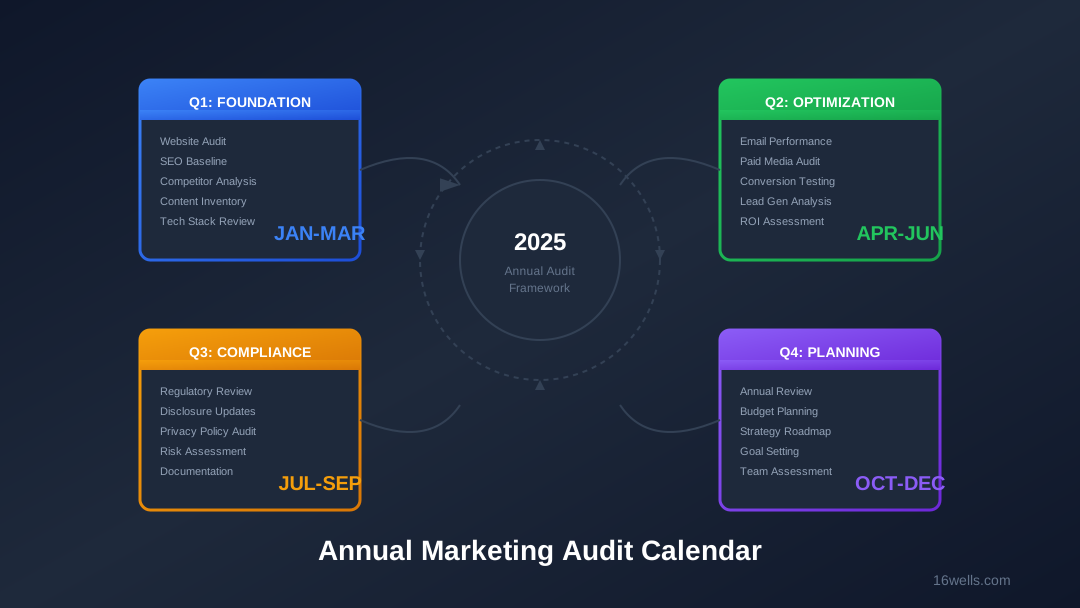
Annual audits set direction. Quarterly reviews maintain momentum and enable adjustment.
Quarterly Review Agenda
Performance review (60 minutes)
- Review KPIs versus targets
- Channel performance analysis
- Campaign performance highlights and lowlights
- Cost per acquisition trends
- Pipeline and conversion analysis
Initiative review (30 minutes)
- Progress on strategic initiatives
- Blockers and resource needs
- Timeline adjustments
Optimization discussion (30 minutes)
- Test results and learnings
- Proposed optimizations
- Budget reallocation recommendations
Planning preview (30 minutes)
- Upcoming quarter priorities
- Resource allocation
- Key milestones and deadlines
Quarterly Metrics Dashboard
Create a standard dashboard reviewed each quarter:
Top-level metrics:
- Marketing-sourced leads
- Marketing-sourced conversions
- Marketing-sourced revenue
- Customer acquisition cost
- Marketing ROI
Channel metrics:
- Traffic by channel
- Leads by channel
- Conversions by channel
- Cost per acquisition by channel
Engagement metrics:
- Email engagement rates
- Content engagement
- Social engagement
- Website engagement
The Optimization Framework
Prioritizing Improvements
Audits generate long lists of potential improvements. Prioritize using this framework:
Impact assessment: How significant is the potential improvement?
- High: Directly affects revenue or major cost reduction
- Medium: Improves efficiency or secondary metrics
- Low: Incremental improvement or nice-to-have
Effort assessment: What’s required to implement?
- Low: Can implement immediately with existing resources
- Medium: Requires project planning and resource allocation
- High: Requires significant investment or organizational change
Prioritization matrix:
- High impact / Low effort: Do immediately (quick wins)
- High impact / Medium-High effort: Plan and resource (strategic priorities)
- Medium impact / Low effort: Do when capacity allows (efficiency gains)
- Low impact or High effort without high impact: Deprioritize or eliminate
Testing Framework
Many optimization opportunities should be tested before full implementation:
Hypothesis formation: What do you believe will improve? By how much?
Test design: How will you isolate the variable? What’s the control?
Success criteria: What result confirms or rejects the hypothesis?
Sample size: How much data is needed for statistical significance?
Timeline: How long must the test run?
Documentation: Record results for organizational learning.
Budget Reallocation Process
Audit findings often indicate budget should shift between channels or activities. Approach reallocation carefully:
- Quantify current allocation: Where does every dollar go?
- Assess ROI by allocation: What’s the return on each bucket?
- Model reallocation scenarios: What happens if we shift X from A to B?
- Consider lag effects: Some channels have delayed results; don’t cut too fast
- Test before committing: Pilot significant shifts before full reallocation
- Monitor closely: Track impact of reallocations weekly initially
Audit Deliverables
Executive Summary
Create a one-page summary for leadership that includes:
- Overall marketing performance vs. objectives
- Top 3 wins and top 3 challenges
- Key competitive insights
- Recommended strategic adjustments
- Resource/budget recommendations
Detailed Findings Document
Comprehensive documentation including:
- Full performance data by channel
- Strategic alignment analysis
- Competitive analysis details
- Operational assessment
- Complete recommendations with prioritization
Action Plan
Translate findings into an executable plan:
- Specific initiatives with owners and timelines
- Quick wins to implement immediately
- Strategic projects with milestones
- Budget reallocation recommendations
- Resource requirements
- Success metrics for each initiative
FAQ
How long does a comprehensive marketing audit take?
A thorough annual audit typically takes 4-6 weeks including data gathering, analysis, and documentation. The time investment depends on data availability—organizations with mature analytics and reporting can move faster. Plan for significant time upfront to establish data sources and build reporting frameworks that make future audits more efficient.
Who should be involved in the marketing audit process?
At minimum, involve marketing leadership, key channel managers, and someone from finance who understands marketing costs. For strategic alignment sections, include business leadership and sales. Consider bringing in outside perspective—internal teams often have blind spots that external reviewers catch.
What if we don’t have good data for certain channels?
Data gaps are common findings in marketing audits. Document what you can’t measure and prioritize fixing those gaps. In the meantime, use directional indicators, industry benchmarks, and qualitative assessment. Don’t let perfect data be the enemy of actionable analysis—make decisions with the data available while improving measurement for the future.
How do we handle channels with long sales cycles in quarterly reviews?
For channels where conversions take months, track leading indicators quarterly while measuring conversions annually. Content marketing might track traffic and engagement quarterly while measuring influenced conversions over longer periods. Use cohort analysis to understand how this quarter’s activities will likely convert over time.
Should we benchmark against competitors or our own historical performance?
Both. Internal historical comparison shows improvement trajectory. Competitive benchmarking shows market position. Internal comparison is more actionable for optimization; competitive comparison is more relevant for strategic positioning. Use competitive benchmarks to set targets and internal trends to measure execution.
How often should we completely overhaul our marketing strategy based on audit findings?
Major strategic overhauls should be rare—annual audits should lead to evolution, not revolution. If audits consistently reveal the need for major changes, the issue is likely strategy setting, not audit findings. Plan for 70% of activities to continue, 20% to be optimized, and 10% to be replaced or eliminated each year.
Key Takeaways
- Audit across four domains: Performance, strategy, competitive, and operational audits together provide complete visibility into marketing effectiveness.
- Solve attribution first: Multi-touch attribution is essential for understanding true channel performance in businesses with long sales cycles.
- Align marketing to strategy: The most common finding in audits is misalignment between marketing activities and business priorities.
- Know your competition: Competitive analysis reveals positioning opportunities and threats that internal analysis misses.
- Review quarterly, audit annually: Quarterly reviews maintain momentum; annual audits set strategic direction.
- Prioritize ruthlessly: Use impact/effort matrices to focus on improvements that matter most.
- Test before committing: Major changes should be validated through testing before full implementation.
- Document and communicate: Audit value comes from action; clear documentation and communication drive organizational change.