
TL;DR: Email marketing for regulated financial services firms doesn’t have to be a compliance nightmare. The key is building templates that bake in required disclosures, avoid common regulatory triggers, and still drive engagement. This article provides frameworks for the most common email types—welcome sequences, educational series, product announcements, and re-engagement campaigns—along with specific language guidance and disclosure requirements that satisfy regulators and internal compliance teams across wealth management, fintech, insurance, lending, and other financial services verticals.
Reading Time: 13 minutes
The Compliance-Marketing Tension
Every marketer at a regulated financial services firm knows the feeling: you craft an email that would drive results at any other company, send it to compliance for review, and watch it come back redlined beyond recognition. Required disclosures get added. Claims get softened. Headlines get neutered. By the time the email is approved, it barely resembles what you wrote—and it certainly won’t perform.
This tension between marketing effectiveness and regulatory compliance isn’t going away. If anything, scrutiny on financial services marketing communications continues to increase. But the answer isn’t to accept bland, ineffective emails as inevitable. The answer is to build templates and frameworks that satisfy compliance requirements from the start while still engaging your audience.
At 16wells, we’ve helped dozens of regulated financial services firms develop compliant email marketing programs—from wealth management to fintech, insurance to lending. The firms that succeed aren’t the ones constantly battling compliance—they’re the ones who’ve built systems where compliance and marketing work together.
This article provides the template library and framework we’ve developed through that experience.
Understanding the Regulatory Landscape
SEC and FINRA Requirements for Investment Advisers and Broker-Dealers
For investment advisers and broker-dealers, SEC and FINRA rules govern communications with the public. Key requirements include:
SEC Marketing Rule (Rule 206(4)-1): Investment advisers must ensure all communications are fair, balanced, and not misleading. They must provide a sound basis for evaluating facts and include proper disclosures about risks.
FINRA Rule 2210 (Communications with the Public): For broker-dealers, all communications must be fair and balanced, with prominent risk disclosures. Performance data requires specific time periods and disclaimers.
Investment-specific requirements: Communications about investment products must include appropriate risk disclosures. They cannot promise specific results or imply that any investment approach is appropriate for everyone.
State Insurance Regulations
For insurance companies and agencies, state insurance departments impose communication requirements:
Unfair Trade Practices: All promotional material must be truthful and not misleading. It cannot make claims about benefits without disclosing limitations.
Policy disclosure: Insurance communications must include appropriate disclosure language about coverage terms and limitations.
Licensing requirements: Communications must identify licensed entities and may require specific producer information.
Consumer Financial Protection Bureau (CFPB) for Lending
Lenders and fintech companies fall under CFPB oversight. Communication requirements include:
Truth in Lending: Marketing cannot be deceptive about rates, terms, or costs.
Equal Credit Opportunity: Communications cannot discriminate or discourage applications.
Fair practices: All marketing must be fair, not deceptive, and not abusive.
Common Compliance Triggers
Certain language patterns consistently trigger compliance concerns. Understanding these helps you avoid them in drafts:
- Absolute claims: “You will profit,” “guaranteed returns,” “risk-free”
- Urgency without substance: “Act now before it’s too late,” “limited time opportunity”
- Outcome promises: Specific dollar amounts, return projections, lifestyle claims
- Simplification of risk: “Easy profits,” “simple system,” “anyone can do it”
- Unbalanced presentation: Discussing potential gains without proportionate risk discussion
- Testimonials without context: Customer success stories without appropriate disclaimers
Template Framework: Welcome Sequence
The welcome sequence is often a firm’s first extended communication with new prospects or customers. Getting it right sets the tone for the relationship while satisfying compliance requirements.
Email 1: Welcome and Expectation Setting
Purpose: Confirm subscription, set expectations, provide immediate value
Subject Line Framework: “Welcome to [Company Name] — Here’s What to Expect”
Structure:
- Greeting and confirmation of subscription/account
- Brief company positioning (educational focus, not outcome promises)
- What they’ll receive and how often
- Immediate value offer (guide, video, resource)
- Clear next steps
- Standard footer with required disclosures
Compliant Language Example:
“Thank you for joining [Company Name]. We’re committed to providing educational resources that help clients develop their understanding of financial planning and make more informed decisions.
Over the coming weeks, you’ll receive:
- Weekly insights and educational content
- Guides to help you understand key financial concepts
- Information about our services and tools
To get started, here’s our guide to [Topic] — it covers the fundamentals every client should understand.
[Standard Risk Disclosure]
[All investments involve risk, including potential loss of principal. Past performance does not guarantee future results.]”
Email 2: Educational Value
Purpose: Demonstrate expertise, provide substantive education
Subject Line Framework: “Understanding [Specific Topic]: What Most People Get Wrong”
Structure:
- Hook that identifies a common challenge or misconception
- Educational content that addresses the challenge
- Practical application or framework
- Link to deeper resource
- Soft positioning of company services
- Required disclosures
Key Compliance Considerations:
- Educational claims should be supportable
- Examples should be clearly hypothetical when appropriate
- Risk discussions should be proportionate to opportunity discussions
Email 3: Company Story and Credibility
Purpose: Build trust through company background and credentials
Subject Line Framework: “Why We Focus on [Core Value/Approach]”
Structure:
- Company founding story or philosophy
- Credentials and expertise (verifiable facts only)
- Approach to service
- What makes the company different (without competitive disparagement)
- Invitation to engage further
- Required disclosures
Template Framework: Educational Series
Educational email series are the safest and most effective email type for regulated financial services firms. They provide genuine value while demonstrating expertise.
Series Structure
A compliant educational series typically follows this arc:
Email 1: Foundation — Core concepts and terminology
Email 2: Application — How concepts apply in practice
Email 3: Common Mistakes — What to avoid
Email 4: Advanced Considerations — Deeper exploration
Email 5: Next Steps — How to continue learning
Educational Email Template
Subject Line Framework: “[Topic] Explained: [Specific Angle or Benefit]”
Structure:
- Opening that establishes relevance
- Core educational content (500-800 words)
- Practical example (clearly marked as hypothetical or historical)
- Key takeaways in bullet format
- Resource for further learning
- Required disclosures
Compliant Example Structure:
Subject: Diversification Explained: Why Asset Allocation Matters
Most investors understand that diversification reduces risk. But stopping there leaves significant planning factors unaddressed.
[Educational content about diversification and asset allocation]
Hypothetical Example:
Consider a hypothetical investor who has all their assets in a single sector…
[Example walkthrough with clear hypothetical framing]
Key Points:
- [Takeaway 1]
- [Takeaway 2]
- [Takeaway 3]
For a deeper exploration of asset allocation, download our comprehensive guide.
All investments involve risk, including potential loss of principal. The examples above are hypothetical and for educational purposes only. Past performance does not guarantee future results. This is not personalized investment advice.
Template Framework: Product/Service Announcements
Announcing new products, features, or services requires balancing promotional language with regulatory requirements.
New Product Launch Template
Subject Line Framework: “Introducing [Product Name]: [Factual Description]”
Structure:
- Announcement and brief description
- What the product/service includes (factual, not promotional)
- Who it’s designed for (with appropriate caveats)
- How to access or learn more
- Required disclosures (prominent placement)
Compliant vs. Non-Compliant Examples:
Non-Compliant: “Our new service will help you profit from the market’s biggest moves. Join now and start making money today!”
Compliant: “We’re introducing [Product Name], a service that provides analysis and educational resources to help you make more informed financial decisions. The service is designed for clients who want additional perspective on market conditions. All investment decisions involve risk, and past performance does not guarantee future results.”
Feature Update Template
Subject Line Framework: “New in [Platform Name]: [Feature Description]”
Structure:
- Feature announcement
- What the feature does (factual description)
- How to access it
- Educational content about using it effectively
- Required disclosures
Template Framework: Re-Engagement Campaigns
Re-engaging inactive subscribers or customers requires careful balance—you want to create urgency without making inappropriate claims.
Re-Engagement Email Template
Subject Line Framework: “We’ve Updated [Specific Thing] — Take a Look”
Structure:
- Acknowledgment of inactivity (without guilt)
- What’s new or improved (factual)
- Educational value available
- Clear call to action
- Option to unsubscribe (CAN-SPAM compliance)
- Required disclosures
Compliant vs. Non-Compliant Urgency:
Non-Compliant: “You’re missing out on huge opportunities! The market is moving and you need to act now!”
Compliant: “We’ve added new educational resources to help clients understand current market conditions. Here’s what’s available if you’re ready to continue learning.”
Required Disclosures Reference
Standard Investment Disclosure
Investing involves risk, including the potential loss of principal. Past performance does not guarantee future results. This information is educational in nature and not a recommendation to buy or sell any security. Please consult with a qualified financial advisor before making investment decisions.
Standard Insurance Disclosure
Insurance products are subject to terms, conditions, and exclusions not described here. Coverage may not be available in all states. Please review policy documents carefully for complete details about coverage, costs, and limitations.
Performance Disclaimer
Past performance is not indicative of future results. Any investment involves substantial risks, including the potential for complete loss of principal. The examples provided are hypothetical and for educational purposes only. Individual results will vary.
Testimonial Disclaimer
Testimonials appearing on this communication may not be representative of the experience of other customers. Past performance is not indicative of future performance or success. Testimonials are not paid unless otherwise indicated.
Building Your Compliant Template Library
Pre-Approval Process
The most efficient approach is to get template frameworks pre-approved by compliance, then populate them with specific content:
- Develop template structures with placeholder content
- Submit templates with various content examples for compliance review
- Document approved language patterns and disclosure requirements
- Create guidelines for marketing team to work within approved frameworks
- Establish expedited review process for template-compliant emails
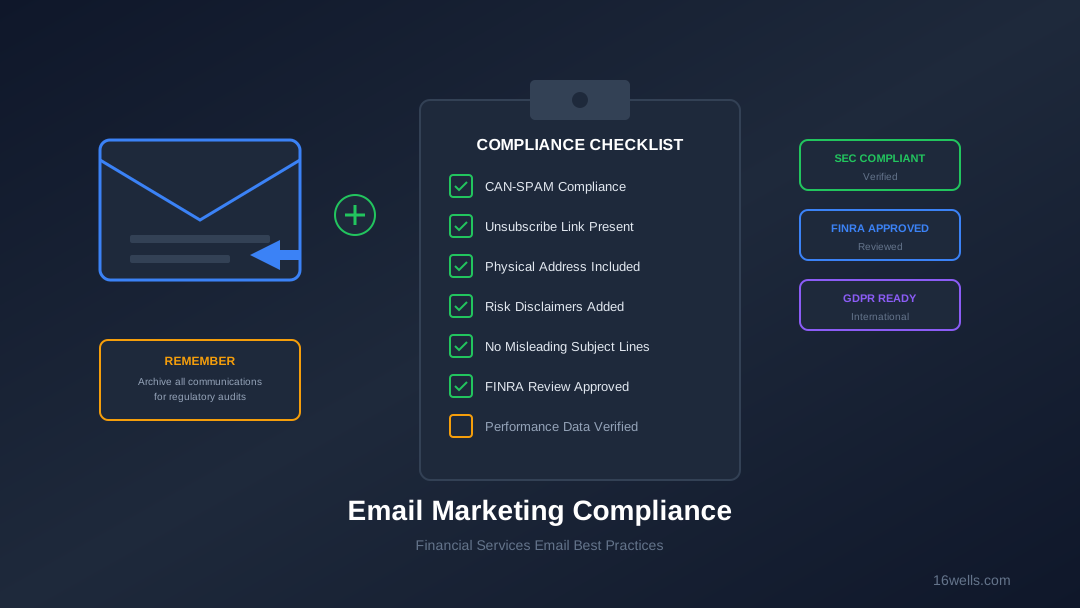
Compliance Checklist for Each Email
Before submitting any email for review, verify:
- No absolute claims or guarantees
- Risk discussion proportionate to opportunity discussion
- All examples clearly marked as hypothetical when appropriate
- Required disclosures present and prominent
- No misleading subject lines or preview text
- CAN-SPAM compliance (unsubscribe option, physical address)
- Links lead to appropriate, reviewed destinations
- No competitor disparagement
- Testimonials properly disclaimed if present
Creating a Swipe File of Approved Language
Over time, build a library of pre-approved language patterns:
Approved subject line structures:
- “Understanding [Topic]: [Educational Angle]”
- “[Number] Things Every Investor Should Know About [Topic]”
- “New Resource: [Factual Description]”
Approved CTA language:
- “Learn more about [topic]”
- “Download the guide”
- “Explore our educational resources”
- “See how [product] works”
Approved benefit language:
- “Designed to help you understand…”
- “Resources for developing your knowledge of…”
- “Tools to support your financial education…”
FAQ
Can we include testimonials in our emails?
Yes, but with significant requirements. Testimonials must be accompanied by disclaimers stating they may not be representative of all customer experiences. Any performance-related testimonials need additional disclaimers about past performance not guaranteeing future results. Generally, it’s safer to use testimonials about service quality and education rather than investment or financial outcomes.
How do we create urgency without compliance issues?
Focus urgency on legitimate deadlines (webinar dates, limited seat availability) rather than market opportunity. “Register by Friday to secure your spot” is compliant. “Act now before you miss these market gains” is not. Time-based urgency around educational events or enrollment periods works well.
Can we reference current market conditions?
Yes, but carefully. Educational discussion of market conditions is generally acceptable. Implying that current conditions create profit opportunities, or that your services will help capitalize on specific situations, requires careful language. Focus on education and understanding rather than profit potential.
What about abandoned cart or trial expiration emails?
These are acceptable but should focus on the educational value of what they’re leaving behind, not on missed profit opportunities. “Your free trial of [educational service] expires tomorrow — access your learning resources before they’re gone” is appropriate. Claims about missing profit opportunities are not.
How often should we review and update our templates?
Review templates at least annually or whenever significant regulatory guidance changes. Keep documentation of compliance approvals with dates, and update templates when rules change. Track which templates generate compliance questions or rejections and revise accordingly.
Should disclaimers be at the bottom of the email or throughout?
Required disclaimers should be prominent and proportionate to the claims made. If you discuss risk-related topics in the body, risk disclosures should be nearby, not just at the bottom. Standardized legal disclaimers typically go in footers, but specific claims may require adjacent disclaimers. When in doubt, err toward more prominent placement.
Key Takeaways
- Build compliance in from the start: Templates designed with regulatory requirements produce better results than emails that get redlined in review.
- Focus on education over promotion: Educational content has the most compliance flexibility and often performs best anyway.
- Create pre-approved frameworks: Getting template structures approved allows faster content production within compliant boundaries.
- Balance risk and opportunity discussions: Every mention of potential benefits should be matched with appropriate risk context.
- Document approved language patterns: Building a swipe file of compliant phrases speeds production and reduces rejections.
- Use legitimate urgency only: Time-based urgency around real deadlines works; manufactured urgency around market opportunity doesn’t.
- Prominently place required disclosures: Burying disclaimers creates risk; prominent placement builds trust and satisfies requirements.