
TL;DR: Google’s AI Overviews have fundamentally changed how financial services firms and data-driven businesses need to approach SEO. The old playbook of ranking on page one and collecting clicks is broken—AI now answers many queries directly, reducing click-through rates for traditional results. Winners in this new landscape are optimizing for Answer Engine Optimization (AEO), structuring content to be cited by AI systems, building topical authority that AI trusts, and diversifying traffic sources beyond Google. This guide provides the complete framework for financial services SEO in the AI era.
Reading Time: 14 minutes
The Traffic Cliff Nobody Saw Coming
In March 2024, a financial services firm we work with saw their organic traffic drop 34% virtually overnight. Their rankings hadn’t changed. Their content was still there. But Google’s AI Overview was now answering queries that used to drive visitors to their site—directly in the search results.
Welcome to the new reality of SEO for financial services.
For two decades, the SEO playbook was relatively stable: research keywords, create optimized content, build authority, rank well, and collect clicks. That playbook still has elements that matter, but the fundamental assumption—that ranking well translates to traffic—is no longer reliable.
Google’s AI Overviews, launched widely in 2024 and now appearing for roughly 40% of searches, fundamentally change the game. For financial services firms—whether wealth management, fintech, insurance, or lending—which often target informational queries around topics like “how to roll over a 401k” or “what is term life insurance,” the impact is significant.
But here’s the thing: this isn’t a disaster. It’s a strategic shift. The firms that understand how AI search works and optimize accordingly are finding new opportunities. Those that keep running the old playbook are watching their traffic erode.
Let’s break down what’s actually happening and how to respond.
Understanding the AI Search Landscape
How AI Overviews Work
Google’s AI Overviews synthesize information from multiple sources to provide direct answers to user queries. For a search like “best retirement account for self-employed,” the AI might generate a comprehensive comparison of SEP-IRAs, Solo 401(k)s, and SIMPLE IRAs—pulling information from various financial websites and presenting it in a consolidated format.
The user gets their answer without clicking through to any website. The sources cited get modest visibility but dramatically reduced traffic compared to traditional search results.
This matters enormously for financial services because:
- Financial topics are heavily targeted by AI Overviews due to high informational intent
- The YMYL (Your Money Your Life) nature of financial content makes AI responses more conservative and source-dependent
- Complex financial topics often require nuanced explanations that AI can now provide
- Many financial queries have clear, factual answers that AI can deliver directly
The Click-Through Rate Collapse
Data from multiple sources confirms what we’re seeing with clients: click-through rates for queries with AI Overviews drop 30-60% compared to traditional results. Even ranking #1 doesn’t guarantee the traffic it once did.
A financial education site ranking first for “what is a Roth IRA” might have gotten 15% click-through rate historically. With an AI Overview answering that query directly, click-through might drop to 5-7%—and that’s if you’re cited in the overview.
This isn’t speculation. We’re tracking these changes across our financial services clients and seeing consistent patterns:
- Informational queries with clear answers: 40-60% traffic decline
- Comparison queries: 30-45% traffic decline
- How-to queries: 25-40% traffic decline
- Complex, nuanced queries: 10-20% traffic decline (AI less confident)
- Branded queries: Minimal impact
The Rise of Alternative AI Search
Google isn’t the only player anymore. ChatGPT, Claude, Perplexity, and other AI systems are becoming direct search competitors. Users increasingly start their research in AI chat interfaces rather than traditional search.
For financial services firms, this means optimizing for multiple AI systems, not just Google. Each has different approaches to sourcing and citing information, creating a more complex optimization landscape.
Answer Engine Optimization (AEO): The New Framework
What AEO Actually Means
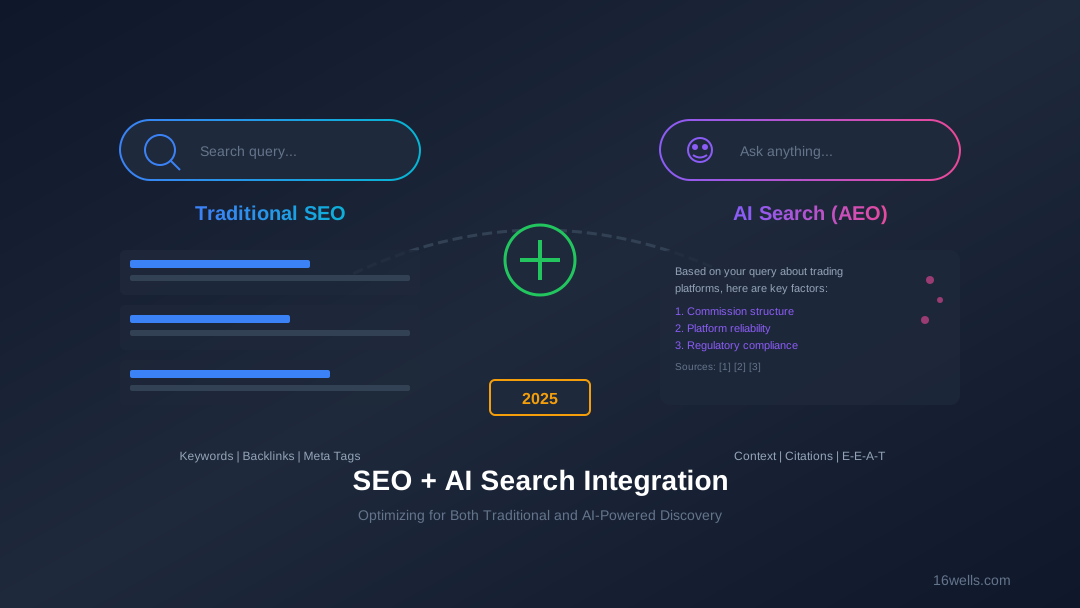
Answer Engine Optimization is the practice of structuring content so that AI systems can easily understand, trust, and cite it. It’s not a replacement for traditional SEO—it’s an evolution that adds new requirements to the familiar optimization process.
AEO focuses on:
Answer clarity: Providing clear, direct answers that AI can extract and present.
Source authority: Building signals that make AI systems trust your content as a reliable source.
Structural optimization: Formatting content in ways that AI can easily parse and understand.
Fact density: Including specific, verifiable facts that AI systems prefer when generating responses.
The AEO Content Framework for Financial Services
Here’s how to structure financial services content for the AI era:
1. Lead with the Answer
AI systems prioritize content that answers the query directly and quickly. For financial content, this means:
- Opening paragraphs should contain clear answers to the primary query
- Use the “inverted pyramid” structure—most important information first
- Don’t bury answers behind lengthy introductions
Example: For a page targeting “what is the contribution limit for a Roth IRA,” the first paragraph should state the current limit clearly, not build up to it over several paragraphs.
2. Structure for Extraction
AI systems extract information more easily from well-structured content. This means:
- Using clear H2 and H3 headings that match query intent
- Implementing bulleted lists for specifications, limits, and requirements
- Using tables for comparisons and data
- Including FAQ sections with clear question-answer formats
3. Include Specific, Verifiable Facts
AI systems prefer content with concrete data over vague generalizations. Financial content should include:
- Current numbers and limits (contribution limits, income thresholds)
- Specific dates and deadlines
- Regulatory citations where relevant
- Statistical data with sources
4. Build Topic Clusters, Not Just Pages
AI systems evaluate topical authority—whether a site demonstrates comprehensive expertise on a subject. For financial services, this means:
- Creating interconnected content that covers topics thoroughly
- Building out supporting content for primary topics
- Internal linking that demonstrates topical relationships
- Updating and maintaining content clusters over time
Practical SEO Strategies for Financial Services in 2025
Strategy 1: Target AI-Resistant Queries
Not all queries are equally vulnerable to AI Overview cannibalization. Focus on queries where AI is less confident or where users still want to click through:
Complex, judgment-based queries: “Is a traditional IRA or Roth IRA better for my situation” requires nuance that AI handles less well than “what is a Roth IRA.”
Current events and time-sensitive content: AI Overviews are less common for rapidly changing information. Market analysis, regulatory changes, and economic commentary are more click-through resilient.
Tool and calculator searches: Users searching for “retirement calculator” or “mortgage calculator” want to use a tool, not read about one.
Review and comparison queries with subjective elements: “Best wealth management platform for small businesses” involves preferences that users want to evaluate themselves.
Strategy 2: Optimize for AI Citation
If AI is going to answer queries with your content, you want to be cited. Cited sources get visibility and some click-through, while uncited sources get nothing. To improve citation likelihood:
Be the most authoritative source: AI systems prioritize established, trusted sources. Build domain authority through quality content, legitimate backlinks, and consistent expertise signals.
Answer queries more completely than competitors: AI prefers comprehensive sources that address queries thoroughly.
Update content regularly: AI systems favor current content, especially for topics where information changes.
Include clear attribution for facts: AI is more likely to cite sources that themselves cite reputable sources for data and claims.
Strategy 3: Build Featured Snippet Positions
Featured snippets—the “position zero” results—are often the source for AI Overviews. Optimizing for featured snippets increases the likelihood of AI citation:
Question-answer format: Structure content as clear questions followed by direct answers.
Paragraph snippets: For definitional queries, provide 40-60 word clear definitions that can be extracted.
List snippets: For process or step-based queries, use numbered lists.
Table snippets: For comparison queries, use well-structured tables.
Strategy 4: Diversify Beyond Google
As Google traffic becomes less reliable, smart financial services firms are diversifying:
YouTube SEO: Video results are less cannibalized by AI Overviews. Financial education content on YouTube can drive traffic that Google organic no longer delivers.
AI chat optimization: Ensure your content is structured to be discovered and cited by ChatGPT, Claude, and Perplexity.
Social search: Platforms like Reddit and Twitter increasingly serve as search engines. Having presence in relevant discussions drives discovery.
Direct and referral traffic: Building email lists, partnerships, and direct audiences reduces dependence on any single traffic source.
Strategy 5: Convert Existing Rankings to Brand Searches
Branded search is largely unaffected by AI Overviews. Users searching for “[Your Company Name] retirement planning” will reach your site regardless of AI features. The strategy:
Brand building in content: Ensure your content associates your brand with specific topics and expertise.
Memorable frameworks and concepts: Create named methodologies or frameworks that users will search for specifically.
Consistent thought leadership: Build recognition so that users search for your perspective specifically.
Content Strategy Adjustments
Rethinking the Content Calendar
The traditional approach of churning out keyword-targeted blog posts is less effective when AI answers those keywords directly. Instead, focus on:
Depth over breadth: Fewer, more comprehensive pieces rather than many thin articles.
Original research and data: Content with proprietary information that AI can’t generate independently.
Expert perspectives: Opinion and analysis that requires human judgment and experience.
Current analysis: Time-sensitive content that AI handles less well.
The E-E-A-T Imperative
Google’s E-E-A-T guidelines (Experience, Expertise, Authoritativeness, Trustworthiness) matter more than ever for AI citation. For financial services content:
Experience: Demonstrate first-hand experience with the topics you cover. Case studies, client examples (anonymized), and personal perspective all help.
Expertise: Display credentials prominently. CFP, CFA, CPA designations should be visible on author bios and content.
Authoritativeness: Build external signals through citations, mentions, and links from recognized financial sources.
Trustworthiness: Clear disclosures, compliance statements, and transparent business practices all contribute.
Technical SEO for the AI Era
Schema Markup That Matters
Structured data helps AI systems understand your content. For financial services, prioritize:
- Article schema with author, date, and organization information
- FAQ schema for question-answer content
- HowTo schema for procedural content
- Financial product schema where applicable
- Author schema with credentials and expertise indicators
Site Architecture for Topical Authority
AI systems evaluate site-wide topical authority. Structure your site to demonstrate comprehensive expertise:
- Topic hub pages that link to related detailed content
- Logical URL structures that reflect topical relationships
- Internal linking that creates clear topic clusters
- Breadcrumb navigation that shows content hierarchy
Page Speed and Technical Fundamentals
Technical SEO fundamentals still matter, potentially more than before as competition for remaining clicks intensifies:
- Core Web Vitals optimization
- Mobile-first design and functionality
- Clean, crawlable site architecture
- Fast, reliable hosting
Measuring Success in the AI Era
New Metrics That Matter
Traditional SEO metrics need updating for the AI search landscape:
AI Overview presence: Track whether your content appears in AI Overviews for target queries.
Citation rate: Monitor how often AI systems cite your content versus competitors.
Click-through rate by query type: Segment CTR analysis by query categories to identify AI impact.
Branded search growth: Track increases in branded searches as a measure of awareness building.
Traffic quality over quantity: Focus on conversion rates and engagement as raw traffic becomes less reliable.
Setting Realistic Expectations
The harsh reality: organic traffic from informational queries will likely decline for most financial services sites, regardless of optimization efforts. Success in this environment means:
- Declining traffic slower than competitors
- Converting existing traffic more effectively
- Growing branded and direct traffic
- Diversifying traffic sources
- Building sustainable competitive advantages in AI citation
FAQ
Should financial services firms give up on SEO?
Absolutely not. SEO isn’t dead—it’s evolving. Organic search still drives significant traffic and leads for financial services. The firms that adapt to AI search will gain competitive advantage as others retreat. The key is updating strategies and expectations, not abandoning the channel.
How do I know if AI Overviews are affecting my traffic?
Compare traffic trends for specific queries before and after AI Overview rollout. Use tools that track AI Overview presence for your target keywords. If you see traffic declines for queries where you maintain rankings, AI Overviews are likely the cause. Google Search Console data can help identify click-through rate changes at the query level.
Is it worth optimizing for ChatGPT and other AI systems?
Yes, increasingly so. While Google still dominates search, alternative AI systems are growing rapidly and have different optimization requirements. Having content that these systems understand and cite creates competitive advantage and diversifies your traffic sources.
How important is video for financial services SEO now?
More important than ever. YouTube is the second-largest search engine, and video results are less affected by AI Overviews than text results. Financial services firms with strong YouTube presence are seeing video traffic offset declines in traditional organic traffic.
Will AI Overviews get worse for publishers?
Likely, yes. Google continues to expand AI Overview presence, and the technology is improving. Planning for a future with even more AI-answered queries is prudent. Building direct audiences, email lists, and brand awareness provides insurance against continued AI search expansion.
How should I adjust my content production?
Shift toward fewer, higher-quality pieces with original insights, current analysis, and comprehensive coverage. Generic informational content that AI can easily replicate has diminishing returns. Content with unique data, expert perspectives, and proprietary frameworks has increasing value.
Key Takeaways
- AI Overviews have changed the traffic equation: Ranking well no longer guarantees traffic. Click-through rates are declining significantly for informational queries.
- Answer Engine Optimization is essential: Structure content for AI extraction and citation, not just traditional ranking factors.
- Target AI-resistant queries: Focus on complex, judgment-based, and time-sensitive queries where AI is less confident.
- Build for citation: Establish authority signals that make AI systems trust and cite your content.
- Diversify traffic sources: YouTube, alternative AI systems, and direct audiences reduce Google dependence.
- Quality over quantity: Fewer comprehensive pieces with original insights outperform high-volume generic content.
- Measure what matters now: Track AI presence, citation rates, and traffic quality, not just rankings and raw traffic.